

Ah, the old Bad Batch theory!No, just experience in manufacturing and polymer science
Register a free account today to become a member! Once signed in, you'll be able to contribute to the community by adding your own topics, posts, and connect with other members through your own private inbox! INEOS Agents, Dealers or Commercial vendors please use the contact us link at the bottom of the page.
Ah, the old Bad Batch theory!No, just experience in manufacturing and polymer science

my heart wants to say yes but the head says noNo, just experience in manufacturing and polymer science

That’s why I suggested changing cv’s periodically may not be the solution. You may toss a good one for a bad one.No, just experience in manufacturing and polymer science

From the various quotes on milage and lift v's no lift, I have a very similar view to yourself. Some have quoted high speed driving as a factor, others it's the offroad use, then it's the lift and finally a combination of everything where some have gone and others haven't.That’s why I suggested changing cv’s periodically may not be the solution. You may toss a good one for a bad one.

Yes, but your rendering is upside down for the differential angle.I drew this side profile of the boot and drive shaft. Is the red area where the pinching occurs?
View attachment 7919666
I would also like to see a fresh one sliced in half. These are shaped in mold, and the if they wanted to control where the flex was occurring, the thickness would be tapered down in that area. Basically, I don't believe the thin part of the cross section is due to "wear". I don't believe material is just fluffing off, and it's not "extruding" as suggested because there wouldn't be molecular dislocation caused by elastic deformation. There's simply not enough heat being generated. I think its simply a case of the unit spends more time at an angle than the design allotted for, and the bonds are breaking causing a crack, and if there is any variability in the material that can cause a point of more focused elasticity, it's failing there, sooner.From the various quotes on milage and lift v's no lift, I have a very similar view to yourself. Some have quoted high speed driving as a factor, others it's the offroad use, then it's the lift and finally a combination of everything where some have gone and others haven't.
I'm on just short of 30k miles and it's been basically all road use and mainly UK motorways. Last time I looked it was ok, but currently I can't get down there but will check as soon as I can, last time was probably July ish. If I'm looking into failures like this I would assume it's a variance in manufacture or materials.
In our industry we are being pushed to use a % of recycled polymers but they are not suitable and degrade with each use. This has caused intermittent failures for some. I would never recommend recycled content for my products but some do as it offers a monetary saving (tax). Some get misty eyed about the savings and the suppliers have them believe all will be perfect, until it isn't. Black products are much easier to hide recycled materials, which some do. I am not saying any recycled materials are involved or are even detrimental to the CV joint.
This is also before we see who actually manufactured the rubber and if they were the best or the cheapest. Even the best make errors in mouldings or the initial compounding?
Quick AI explanation
Yes, traditional rubber recycling methods, like grinding into crumbs, cause some degradation, but newer technologies like devulcanization aim to break sulfur bonds to recover usable material with minimal property loss, allowing for higher-quality recycled rubber for new products, though some degradation or property changes (like becoming less elastic) can still occur depending on the process and application.
Traditional Recycling (Mechanical)
Process: Grinding vulcanized rubber (like tires) into small particles (crumbs).
Degradation: This method doesn't break the sulfur cross-links, so the rubber acts more like a filler, reducing the overall quality and elasticity of new products. Properties like strength and flexibility can decrease.
Advanced Recycling (Devulcanization)
Process: Uses chemicals, heat (microwave, thermal), or ultrasound to selectively break the carbon-sulfur (C-S) and sulfur-sulfur (S-S) bonds, allowing the rubber to be reformed.
Reduced Degradation: This aims to return the rubber to a workable state without significantly damaging the polymer backbone, making it suitable for higher-value products.
Outcomes: Can create new compounds with less loss of mechanical and physical properties, approaching "virgin" material quality.
Key Takeaway:
While rubber's vulcanized (cross-linked) nature makes it tough to recycle without some property loss, innovative devulcanization methods are minimizing degradation, allowing for more effective, closed-loop recycling and material recovery.
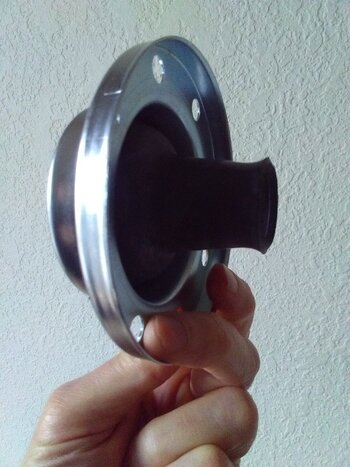
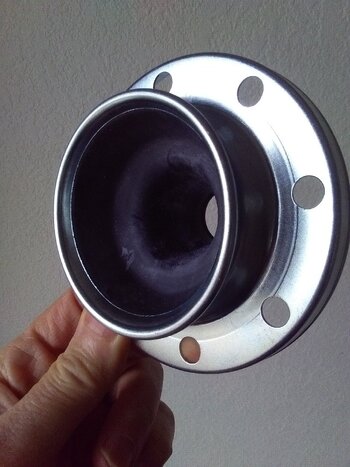
I ordered one from agile yesterday, it's cheaper.Well, you can buy one off Amazon and have it late same day or tomorrow. Cut it open and show us.
TeraFlex JL/JT Factory... https://www.amazon.com/dp/B0CKKD9BJ4?tag=globalgrena0b-20
Would you be willing? Thx!
I would like to see 1000 analysed and tested to distruction. 500 from series production and 500 random as a start.I would also like to see a fresh one sliced in half. These are shaped in mold, and the if they wanted to control where the flex was occurring, the thickness would be tapered down in that area. Basically, I don't believe the thin part of the cross section is due to "wear". I don't believe material is just fluffing off, and it's not "extruding" as suggested because there wouldn't be molecular dislocation caused by elastic deformation. There's simply not enough heat being generated. I think its simply a case of the unit spends more time at an angle than the design allotted for, and the bonds are breaking causing a crack, and if there is any variability in the material that can cause a point of more focused elasticity, it's failing there, sooner.
You seem to know much more about material science than I do, so, how does that read as a simple explanation...

I just don't think the single accordion bend boot design lends itself to being permanently at what? 50% of its angle design (I can't tell, just guessing)? You'll see CV's at the wheels that sit at that angle with 2-5 bends, but they are also rotating at 1/4 the rpm. I really think if this gets solved, it'll be a redesigned front axle housing and a DC joint at the tcase.I would like to see 1000 analysed and tested to distruction. 500 from series production and 500 random as a start.
An analysis of the materials used and considerations of alternatives that may have better properties for the application.
That or the design is a bit sh!t

I was referring to the metal lip needing to be a different shape or larger diameter.Or it should turn inward with the clamp on the inside. I don't know if there's room but it would never get pinched by the rim.
No, because you are still not reducing the CV angle.I was referring to the metal lip needing to be a different shape or larger diameter.
View attachment 7919698
Maybe its time for someone to make a low rider out of this station wagon....
That is the 2027 model, Ineos is moving to the lux market not the enthusiast market.I fixed my CV issue (with ChatGPT). Also lets the wife in easier without installing steps.

 www.onairsuspension.uk
Yea... Honestly, Ive been waiting on the Fournales shocks. I figured I could cut the springs and drop an 1", and then raise it 2" when needed. Sort of the manual version of an LX470 2002 Land Cruiser suspension. Unfortunately, by the time Fournales comes out with the final product, I'd have sold the car, died, or we'll all be at war.Here's an option
Ineos Grenadier full air suspension | On Air Suspension
AKF1250Z AKF1751Z With Ineos’s Grenadier becoming a modern day equivalent to Land Rover’s classic Defender, it is now becoming the new staple for off-road modifications.How about improve it’s versatility with the addition of 4-corner air suspension? On-road manners are improved, access...

This sums up the power of AI and I can only say this: just because you can do something doesn't always mean you should!View attachment 7919700
I fixed my CV issue (with ChatGPT). Also lets the wife in easier without installing steps.
Actually Yes, because this could eliminate the boot pinching @Dokatd noted.No, because you are still not reducing the CV angle.
I was referring to the metal lip needing to be a different shape or larger diameter.

I would be surprised if the front geometry isn't exactly identical to the station wagon. So same problem .My caster is 1.76 and steering is great but I have a longer wheelbase in the QM.