The Grenadier Forum

Register a free account today to become a member! Once signed in, you'll be able to contribute to the community by adding your own topics, posts, and connect with other members through your own private inbox! INEOS Agents, Dealers or Commercial vendors please use the contact us link at the bottom of the page.

Front Drive Shaft Update

I’m sorry this happened to you! Could I ask what exact Fox shocks you have on the front?

I’m just curious to find their extended length in comparison to the factory shock length as it acts as a bit of a limiting strap and might protect the boot.
Fox 2.5 performance elite. Same length as stock.
 
Here is what I have at the moment. This last joint was caught at 5000miles with only a minor tear. This allowed me to remove the boot and compare to the last one I pulled The boot is most certainly being pinched at the extent of full travel even with stock length shocks. You can clearly see the wear on the boot and even the machine marks from the shaft telegraphing into the rubber. The pinch is light, and gently extrudes the rubber boot to the point that the rubber is super thin at the tear point. Eventually the boot can't hang on any longer and finally tears The tear can propagate around the thin portion of the boot or start to move out to the clamp ring depending on a few factors.

Note, the factory and Terra boot maintain full rubber thickness in the area where the boot tears. Over time the boot thins out from a pinching actions. You can clearly see in my pics the boot thins out to almost paper thin. Those who never go Offroad or those who drive pretty smooth roads without whoops or big bumps are likely going to see far more mileage per joint than those that actually use the truck for its intended purpose. People that drive the highway are constantly hitting whoops in the road that cause pinching. The only sure thing right now is to put limiting straps on to prevent the last 1" or so of travel.
IMG_0113.jpeg
IMG_0114.jpeg
image.jpg
IMG_0116.jpeg
image.jpg
image.jpg
 
Last edited:
Lifts just don’t play nice with these trucks.
I was talking to Jay Couch as my flat tray and half box is ready. Sounds like another portal option will be offered. He is working on it and initially we might have two different height options.
 
That rubber gets thin there doesn't it... Thanks for the great work on this detailed breakdown!!!
 
View attachment 7918597

I will post this chart you made again as it has been really helpful for me. FWIW the Agile Fox shocks have a nearly identical extension and compression length as the stock SACHS shocks.
I weighed all the points in this discussion when choosing to get new shocks and springs. I ended up with Koni Raid shocks because of how robust they are, and the extended length is in believe the same if not shorter than stock. I also initially bought the EU lift, 30mm, but haven’t installed that for fear of harming the boot.

On a side note regarding Caster, there has to be something to running the caster as low as possible. I’m at 1.5° caster and at 16k miles, stock suspension, and checked the boot last night and looks new, albeit a bit dirty. I’m considering going to a lower caster angle in the future as I find the “terrible steering” not too bad and what I’d expect from a truck with this front end architecture. One of the members of the NorCal Grenadier group is approaching 75k miles with a 2.5” lift and metalcloak adjustable suspension, at .7° caster and still on the original CV.

Granted, lowering the caster makes for worse highway handling, but I think that’s a fair trade off of potentially longer CV service life.

 
I weighed all the points in this discussion when choosing to get new shocks and springs. I ended up with Koni Raid shocks because of how robust they are, and the extended length is in believe the same if not shorter than stock. I also initially bought the EU lift, 30mm, but haven’t installed that for fear of harming the boot.

On a side note regarding Caster, there has to be something to running the caster as low as possible. I’m at 1.5° caster and at 16k miles, stock suspension, and checked the boot last night and looks new, albeit a bit dirty. I’m considering going to a lower caster angle in the future as I find the “terrible steering” not too bad and what I’d expect from a truck with this front end architecture. One of the members of the NorCal Grenadier group is approaching 75k miles with a 2.5” lift and metalcloak adjustable suspension, at .7° caster and still on the original CV.

Granted, lowering the caster makes for worse highway handling, but I think that’s a fair trade off of potentially longer CV service life.
It is not the end of the world indeed; in Land Rover solid-axle past, each inch of suspension lift took away 1.1 of a degree of caster, with 3 deg factory setting. Most everyone taking their trucks off pavement had at least 2" of lift, leaving barely 0.8. I drove my D1 like that for a decade and a half; it was squirrelly, didn't have a good return to center, and you wouldn't want to take it much past 80 mph. But it was somewhat livable.
 
I weighed all the points in this discussion when choosing to get new shocks and springs. I ended up with Koni Raid shocks because of how robust they are, and the extended length is in believe the same if not shorter than stock. I also initially bought the EU lift, 30mm, but haven’t installed that for fear of harming the boot.

On a side note regarding Caster, there has to be something to running the caster as low as possible. I’m at 1.5° caster and at 16k miles, stock suspension, and checked the boot last night and looks new, albeit a bit dirty. I’m considering going to a lower caster angle in the future as I find the “terrible steering” not too bad and what I’d expect from a truck with this front end architecture. One of the members of the NorCal Grenadier group is approaching 75k miles with a 2.5” lift and metalcloak adjustable suspension, at .7° caster and still on the original CV.

Granted, lowering the caster makes for worse highway handling, but I think that’s a fair trade off of potentially longer CV service life.
How much range do we get with the Grenadier for caster angle?
 
I believe the factory range is 1.25°-2.2°, with 2.0° being the nominal number. I think I’m going to lower mine all the way to 1.25° and see if that too negatively affects the handling or if it’s livable for daily use. I’d really love to install the 30mm eibach lift I have sitting in my garage.
 
Here is what I have at the moment. This last joint was caught at 5000miles with only a minor tear. This allowed me to remove the boot and compare to the last one I pulled The boot is most certainly being pinched at the extent of full travel even with stock length shocks. You can clearly see the wear on the boot and even the machine marks from the shaft telegraphing into the rubber. The pinch is light, and gently extrudes the rubber boot to the point that the rubber is super thin at the tear point. Eventually the boot can't hang on any longer and finally tears The tear can propagate around the thin portion of the boot or start to move out to the clamp ring depending on a few factors.

Note, the factory and Terra boot maintain full rubber thickness in the area where the boot tears. Over time the boot thins out from a pinching actions. You can clearly see in my pics the boot thins out to almost paper thin. Those who never go Offroad or those who drive pretty smooth roads without whoops or big bumps are likely going to see far more mileage per joint than those that actually use the truck for its intended purpose. People that drive the highway are constantly hitting whoops in the road that cause pinching. The only sure thing right now is to put limiting straps on to prevent the last 1" or so of travel.
View attachment 7919625View attachment 7919632View attachment 7919627View attachment 7919637View attachment 7919639View attachment 7919640

Useful post, thanks for sharing.

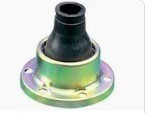
Are you suggesting the boot needs to be more like this:
booot.jpg
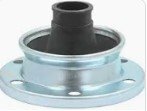
Rather than this?
boooot.jpg
 
Here is what I have at the moment. This last joint was caught at 5000miles with only a minor tear. This allowed me to remove the boot and compare to the last one I pulled The boot is most certainly being pinched at the extent of full travel even with stock length shocks. You can clearly see the wear on the boot and even the machine marks from the shaft telegraphing into the rubber. The pinch is light, and gently extrudes the rubber boot to the point that the rubber is super thin at the tear point. Eventually the boot can't hang on any longer and finally tears The tear can propagate around the thin portion of the boot or start to move out to the clamp ring depending on a few factors.

Note, the factory and Terra boot maintain full rubber thickness in the area where the boot tears. Over time the boot thins out from a pinching actions. You can clearly see in my pics the boot thins out to almost paper thin. Those who never go Offroad or those who drive pretty smooth roads without whoops or big bumps are likely going to see far more mileage per joint than those that actually use the truck for its intended purpose. People that drive the highway are constantly hitting whoops in the road that cause pinching. The only sure thing right now is to put limiting straps on to prevent the last 1" or so of travel.
View attachment 7919625View attachment 7919632View attachment 7919627View attachment 7919637View attachment 7919639View attachment 7919640
The takeaway is that the OEM front shocks allow just enough droop so that the boot comes into light contact with the surrounding metal housing/flange. Not enough contact to immediately destroy the boot but enough that over time the boot is thinned out until eventually it fails once the rubber has become too thin. Given this, any replacement shocks with an extended length longer than OEM will cause the boot to fail more rapidly as the resulting contact between the boot and the metal housing will be greater even if used with factory springs. Taller springs installed as a lift will not increase the boot-flange contact but it will cause the joint to run at a higher angle resulting in more stress on the boot which accelerates degradation of the thinning material.

For owners considering a lift and who want to maximize the life of the CV boot, do not install shocks with a longer extended length. King Shocks for this reason are a definite no go as they are 28.54mm longer than the OEM length of 590mm. The Koni shocks for the Grenadier match the length of the OEM shocks from Sachs. It would be good to know the shock lengths from Fox, Radflo, Eibach, Dobinson, Reiger, Nimbus, Metal Cloak, Owl etc. Most are likely longer than OEM.
 
Here is what I have at the moment. This last joint was caught at 5000miles with only a minor tear. This allowed me to remove the boot and compare to the last one I pulled The boot is most certainly being pinched at the extent of full travel even with stock length shocks. You can clearly see the wear on the boot and even the machine marks from the shaft telegraphing into the rubber. The pinch is light, and gently extrudes the rubber boot to the point that the rubber is super thin at the tear point. Eventually the boot can't hang on any longer and finally tears The tear can propagate around the thin portion of the boot or start to move out to the clamp ring depending on a few factors.

Note, the factory and Terra boot maintain full rubber thickness in the area where the boot tears. Over time the boot thins out from a pinching actions. You can clearly see in my pics the boot thins out to almost paper thin. Those who never go Offroad or those who drive pretty smooth roads without whoops or big bumps are likely going to see far more mileage per joint than those that actually use the truck for its intended purpose. People that drive the highway are constantly hitting whoops in the road that cause pinching. The only sure thing right now is to put limiting straps on to prevent the last 1" or so of travel.
View attachment 7919625View attachment 7919632View attachment 7919627View attachment 7919637View attachment 7919639View attachment 7919640
Did you cut a stock unused boot as a baseline? The material at the bend may be deliberately thinner to prevent the outer edge stretching to begin with.
 
Back
Top Bottom