
The Grenadier Forum

A community driving the extraordinary.

Welcome to Global Grenadiers — the worldwide community for INEOS Grenadier and Quartermaster owners and enthusiasts. Register free to join the conversation. Share your build and adventures, access technical guides, join your regional social group, get help on the trail, and receive our monthly newsletter.

INEOS Agents, Dealers or Commercial vendors — please use the Contact us link at the bottom of the page.

Grenadier TPMS vs ARB Gauge Readings

Notmycamel

Grenadier Owner
Lifetime Supporter
Local time
6:20 PM
Joined
Jul 28, 2025
Messages
8
Location
Arizona
Hey everyone, looking for some input on a tire pressure discrepancy on my Grenadier.

Vehicle has Toyo Open Country RT Trail 35x12.50R17 tires and I’m running Apex Rapid Deflator valves on all four tires.

Using my ARB digital inflator/gauge directly at the valves, I got these cold-ish readings:

Front Left: 34.5 psi
Rear Left: 37 psi
Front Right: 35 psi
Rear Right: 35.5 psi

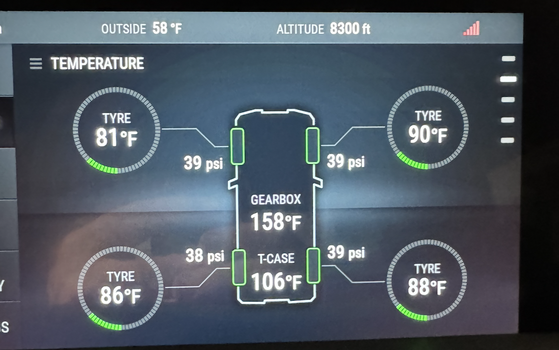
But the factory TPMS screen in the Grenadier shows:

Front Left: 39 psi
Front Right: 39 psi
Rear Left: 38 psi
Rear Right: 39 psi

So the TPMS is reading roughly 2 to 4.5 psi higher than my ARB gauge.

Questions:
  1. Has anyone seen the Grenadier TPMS consistently read higher than a trusted handheld gauge?
  2. Could the Apex Rapid Deflator valves affect TPMS sensor accuracy or sealing in any way?
  3. Is the likely culprit the ARB gauge calibration, the vehicle TPMS calibration, or the valve setup?
  4. Which reading would you trust more for daily use?
For context, tire temps on the screen were around 81 to 90°F when checked.

Appreciate any real-world experience before I start chasing ghosts. Any advice how to calibrate the TPMS for accuracy?
 

Attachments

  • tires.png
    tires.png
    1.2 MB · Views: 9
I’ve noticed the same with mine the TPMS screen is off about about 2 psi. Verified my pressure gauge is accurate against other known good gauges. Also, verified on other vehicles I own with their TPMS screens and everything reads within .2 to .5 psi accuracy against my gauges.

It might be possible for the dealer to calibrate the screen readings but I haven’t heard of anyone else doing so. I trust my gauges more and set the tires to the pressure they show. The screen displays what it displays so long as I know how far it’s off I’m fine with it.

Other than for lower off-road pressures maybe once or twice a year during seasonal temperature changes I have to rest the RCP (Reference Cold Pressure) to avoid any unwanted TPMS warnings. I think besides being a minor annoyance it’s not that big a deal so long as you know you’ve set them based on the accuracy of your pressure gauges.

The bigger issue with the TPMS system is not being able to rotate your tires as needed and have the damn system track the wheel position changes like any other normal modern vehicle with TPMS sensors. Or being able to have a second set of wheels with sensors of the correct frequency and have the system recognized them without the hassle of a dealer visit or reprogramming. Something that has been sorted for years by nearly every other vehicle manufacturer but IA has to do their own thing and add make it complicated.
 
Last edited:
I’ve noticed the same with mine the TPMS screen is off about about 2 psi. Verified my pressure gauge is accurate against other known good gauges. Also, verified on other vehicles I own with their TPMS screens and everything reads within .2 to .5 psi accuracy against my gauges.

It might be possible for the dealer to calibrate the screen readings but I haven’t heard of anyone else doing so. I trust my gauges more and set the tires to the pressure they show. The screen displays what it displays so long as I know how far it’s off I’m fine with it.

Other than for lower off-road pressures maybe once or twice a year during seasonal temperature changes I have to rest the RCP (Reference Cold Pressure) to avoid any unwanted TPMS warnings. I think besides being a minor annoyance it’s not that big a deal so long as you know you’ve set them based on the accuracy of your pressure gauges.

The bigger issue with the TPMS system is not being able to rotate your tires as needed and have the damn system track the wheel position changes like any other normal modern vehicle with TPMS sensors. Or being able to have a second set of wheels with sensors of the correct frequency and have the system recognized them without the hassle of a dealer visit or reprogramming. Something that has been sorted for years by nearly every other vehicle manufacturer but IA has to do their own thing and add make it complicated.
It is easy to replace your TPMS sensors with one's that can have the IDs cloned from your factory IDs. I have 2 sets of wheels with Autel TPMS sensors and the TS508 TPMS tool.

This allows me to easily move wheel placement and keep the IDs that are in the Grenadier configuration. Takes about 4 minutes to change the IDs. The spares have TPMS sensors as well.
 
It is easy to replace your TPMS sensors with one's that can have the IDs cloned from your factory IDs. I have 2 sets of wheels with Autel TPMS sensors and the TS508 TPMS tool.

This allows me to easily move wheel placement and keep the IDs that are in the Grenadier configuration. Takes about 4 minutes to change the IDs. The spares have TPMS sensors as well.
My understand though is you need a specific/older model TS508 not the current TS508WF is that correct?
 
@Notmycamel - The TPMS system uses a pressure sensor (usually a MEMS device) that reports absolute pressure, then corrects that to gauge pressure by subtracting a standard value for atmospheric pressure. So your TPMS sensors won't report what you'll see on a gauge unless
  • your TPMS sensors are accurate
  • your reference gauge is accurate
  • local conditions are standard (i.e., 14.7 psi / 29.92" Hg, 59° F, elevation 0' MSL)
I have several calibrated Bourdon-tube type air gauges that are accurate within ±2%. When I compare those gauge readings against my Autel TPMS sensors, I typically see 1 - 3 psi difference and infrequently up to 4 psi (all measurements of a cold tire).

Recall that tire pressure is a relative measurement - it measures the difference between pressure inside and outside your tire. I live at 8,100' MSL where the standard air pressure is about 12.2 psi. If I set my tires pressures there to 36 psi gauge then drive to sea level, the outside air pressure increases 2.5 psi and the gauge pressure in the tire will drop by the same amount to about 33.5 psi.

One inch of mercury (Hg) is equivalent to about 0.5 psi. It's not uncommon for weather systems to cause air pressure to swing an inch either way (I've seen two inches low in Dutch Harbor where record low pressures have been recorded), so a passing high or low pressure weather system can also affect your gauge tire pressures. Also note that even minor heating of a tire can easily raise pressure by one or two psi. I've made the mistake of setting tire pressures when one side is in the sun and the other side is in the shade. When I checked them later, the formerly hot side was 1 - 2 psi low after it cooled off.

TPMS sensors don't have to be super accurate because - at least by law in the U. S. - (49 CFR § 571.138 S4.2(a)) - the senders are only required to raise a low pressure alert when the tire pressure is 25% below the placarded tire pressure or 20 psi, whichever is higher. As long as they do that, reporting accuracy isn't really a requirement. Twenty-five percent of 36 psi is 9 psi: that's a pretty broad range and likely to encompass any inaccuracy of your TPMS sensors. The real value of TPMS is as a trend-reporting device, i.e., a tire is losing significant amounts of air.

Of course, you can try different TPMS sensors until you find a set of four or five that read as consistently as you like. I have one Autel sensor that always reads 1 psi lower than the rest – it is cheap enough to replace, but it does not bother me enough to do so. Since the TPMS system displays pressure only as whole numbers, rounding is occurring somewhere in the system. The internal precision of the sensor is revealed by the minimum pressure difference that causes the displayed value to change by 1 psi. For example, if raw pressure is recorded to the nearest tenth of a psi, then a measured 36.4 psi displays as 36 while 36.5 psi displays as 37. So if you want to ensure that a true pressure of 36.4 psi does not display as 37, the sensor accuracy must be within 0.1 psi – or about 0.1 / 36 × 100 = 0.28% of reading. That is a very tight tolerance and likely exceeds what most TPMS sensors deliver.
 
Last edited:
@Notmycamel - The TPMS system uses a pressure sensor (usually a MEMS device) that reports absolute pressure, then corrects that to gauge pressure by subtracting a standard value for atmospheric pressure. So your TPMS sensors won't report what you'll see on a gauge unless
  • your TPMS sensors are accurate
  • your reference gauge is accurate
  • local conditions are standard (i.e., 14.7 psi / 29.92" Hg, 59° F, elevation 0' MSL)
I have several calibrated Bourdon-tube type air gauges that are accurate within ±2%. When I compare those gauge readings against my Autel TPMS sensors, I typically see 1 - 3 psi difference and infrequently up to 4 psi (all measurements of a cold tire).

Recall that tire pressure is a relative measurement - it measures the difference between pressure inside and outside your tire. I live at 8,100' MSL where the standard air pressure is about 12.2 psi. If I set my tires pressures there to 36 psi gauge then drive to sea level, the outside air pressure increases 2.5 psi and the gauge pressure in the tire will drop by the same amount to about 33.5 psi.

One inch of mercury (Hg) is equivalent to about 0.5 psi. It's not uncommon for weather systems to cause air pressure to swing an inch either way (I've seen two inches low in Dutch Harbor where record low pressures have been recorded), so a passing high or low pressure weather system can also affect your gauge tire pressures. Also note that even minor heating of a tire can easily raise pressure by one or two psi. I've made the mistake of setting tire pressures when one side is in the sun and the other side is in the shade. When I checked them later, the formerly hot side was 1 - 2 psi low after it cooled off.

TPMS sensors don't have to be super accurate because - at least by law in the U. S. - (49 CFR § 571.138 S4.2(a)) - the senders are only required to raise a low pressure alert when the tire pressure is 25% below the placarded tire pressure or 20 psi, whichever is higher. As long as they do that, reporting accuracy isn't really a requirement. Twenty-five percent of 36 psi is 9 psi: that's a pretty broad range and likely to encompass any inaccuracy of your TPMS sensors. The real value of TPMS is as a trend-reporting device, i.e., a tire is losing significant amounts of air.

Of course, you can try different TPMS sensors until you find a set of four or five that read as consistently as you like. I have one Autel sensor that always reads 1 psi lower than the rest – it is cheap enough to replace, but it does not bother me enough to do so. Since the TPMS system displays pressure only as whole numbers, rounding is occurring somewhere in the system. The internal precision of the sensor is revealed by the minimum pressure difference that causes the displayed value to change by 1 psi. For example, if raw pressure is recorded to the nearest tenth of a psi, then a measured 36.4 psi displays as 36 while 36.5 psi displays as 37. So if you want to ensure that a true pressure of 36.4 psi does not display as 37, the sensor accuracy must be within 0.1 psi – or about 0.1 / 36 × 100 = 0.28% of reading. That is a very tight tolerance and likely exceeds what most TPMS sensors deliver.
I have the ARB Air Compressor Tire Gauge. Is there one that you find to be the most accurate or is this a good one?

 
I find that my granny TPMS readings are not real time. Sometimes they take a minute or two to actually show the tire pressure. I believe other people reported that theirs was much faster reporting. Is that if we have our cars on or off or something?
 
I have the ARB Air Compressor Tire Gauge. Is there one that you find to be the most accurate or is this a good one?
I couldn’t find anything about the ARB gauge’s accuracy on the ARB site. I’d expect an accurate gauge to come with some quantification of its accuracy. That said, if the gauge provides repeatable readings, then that may be good enough for a particular use case.

I’ve been using Accu-Gage products for decades. The ones I’m using are calibrated to ANSI B40.1 Grade B specs which requires an accuracy of ±2% of the whole scale in the middle half. So a 0 - 60 psi gauge would have an accuracy of ± 1.2 psi from 15 - 45 psi. The top and bottom quarters of the scale are ± 3%, so even that isn’t bad. These are inexpensive enough that have 3 or 4 around the shop and occasionally cross check them. I accidentally put 140 psi on one of my 100 psi gauges. I cross-checked it right away and - sure enough - it had been damaged and read about 7 psi high.

This is one case where reasonable quality can be had for a reasonable price. An Accu-Gage RH60X costs less than $20.

On a related matter, I do my own tire work and stumbled across a locking air chuck that is superior to everything else I’ve used. The LockNFlate air chucks stay on Schrader valve stems without damaging them. LNL65001 is open (always open, can’t depress a valve core) and LNL65002 is closed (must depress a Schrader valve for flow). I’ll outfit the latter on an ARB compressor when I install mine.
 
I find that my granny TPMS readings are not real time. Sometimes they take a minute or two to actually show the tire pressure. I believe other people reported that theirs was much faster reporting. Is that if we have our cars on or off or something?
My granny was pretty slow too 😁 Was she off or something ?. . . we don’t really know.
 
Back
Top Bottom