The Grenadier Forum

Register a free account today to become a member! Once signed in, you'll be able to contribute to the community by adding your own topics, posts, and connect with other members through your own private inbox! INEOS Agents, Dealers or Commercial vendors please use the contact us link at the bottom of the page.

Front Drive Shaft Update

I am not sure exactly when or where, I have some fortunate friends who have access to some very remote places that are not open to most.
Ah yes In my younger years I would have visited a number of them when I was flying around the Kimberly in a helicopter doing diamond exploration. My trip next year certainly won’t be getting off the beaten track.

Cheers
Steve
 
Has anyone tried to use an aftermarket high angle boot?
Seems like a plausible solution?
Especially if you already have a rzeppa installed

From my Internet sleuthing:
The ORS-HB201 (Off-Road Solutions) is a "stretchy" silicone boot. Because it is silicone, it has a wide "tolerance" for flange sizes. It is documented to fit flanges from 3.5" up to 5", which covers the Grenadier's housing.
The RCV VL21-10 includes its own mounting flange. You remove the factory boot/flange and bolt the RCV flange directly to your transfer case or differential output, which shares the standard 6-bolt pattern.
 
I don't think it's a good idea to install an additional boot over the original CV joint because you won't be able to see when the original boot fails, and inevitably, centrifugal force will squeeze all the grease out, shooting it into the additional boot. This will quickly cause it to fail due to lack of lubrication. But maybe I'm wrong.
 
Has anyone tried to use an aftermarket high angle boot?
Seems like a plausible solution?
Especially if you already have a rzeppa installed

From my Internet sleuthing:
The ORS-HB201 (Off-Road Solutions) is a "stretchy" silicone boot. Because it is silicone, it has a wide "tolerance" for flange sizes. It is documented to fit flanges from 3.5" up to 5", which covers the Grenadier's housing.
The RCV VL21-10 includes its own mounting flange. You remove the factory boot/flange and bolt the RCV flange directly to your transfer case or differential output, which shares the standard 6-bolt pattern.
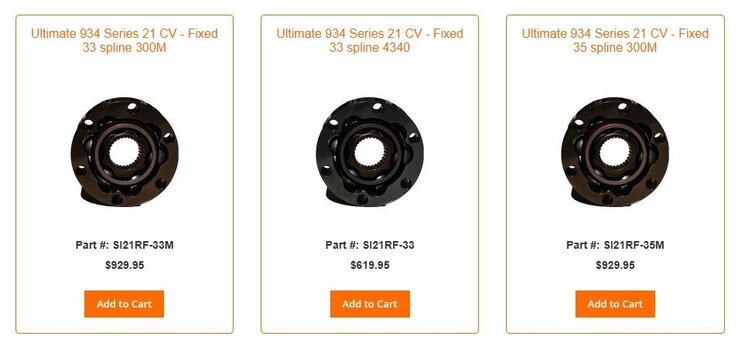
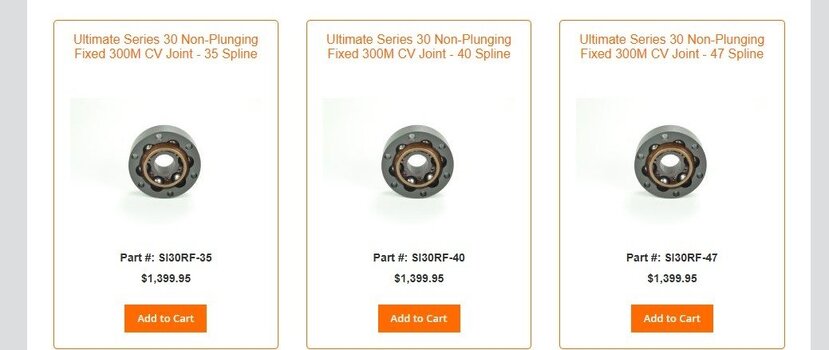
Interesting looking at the RCV website that they do a range of ultimate joints with a lifetime guarantee. The price would indicate that they may be somewhat better than the standard or Teraflex. Not sure if these are for driveshafts or axles though.
rcv.jpgrcv 2.jpg
 
Last edited:
You will cause significant wear to your transfer case and potentially cause failure of your rear differential. I stress potentially as the diff should be more than fine, but you are adding a lot of extra stress and I am not sure yet how robust these axle truly are.
Can you expand on why there will be more stress? Genuinely interested to hear on why the TC will be under more load in full time rear wheel drive than full time four wheel drive (unlocked).

Tks
 
I'm thinking as a replacement, or an improvement when/if I install the rzeppa joint

So without the original boot. Just the new one. Ok, then I think it could also be ok.
We need to figure out if there's enough space to attach the boot on the joint side.
 
Can you expand on why there will be more stress? Genuinely interested to hear on why the TC will be under more load in full time rear wheel drive than full time four wheel drive (unlocked).

Tks
It's not more load, it's that there is slip in the center differential. This is normally take up by both axles being loaded relatively equally. Without the front shaft load you will feel a lot of clunking when going on and off throttle. This will eventually tear up the center diff.
 
Hm. Make an adapter for the ford cv

I'm going to say this again, you cannot run an external boot at the transfer case of a front shaft. All the grease will flow to it, settle and harden when cooled. Then when you get going again the boot will be massively out of balance and tear itself apart. This was even backed up by whoever the Aussie was that contacted that Porsche CV guy.

That Ranger shaft is meant to have that boot at the low end of the shaft so the grease stays in the CV.
 
And finally, for those taking long remote trips, a simple inspection of the CV boot prior to departure is not in any way going to ensure CV reliability on the trip. The boot will literally look perfect one day and then the next it will be shot. The only "sure thing" is to replace the joint prior to heading out.
 
From what I read these boots are pretty commonly used for people in the Toyota and jeep communities. Since terraflex is a common part of a typical dimensions I figured there has to be aftermarket alternatives.

The key difference in the rcv product is that it's made from a material that handles bends and friction really well. The bellows allows for expansions and contraction well.

Seems like it should work well for our use, and I rather invest a bit into buying a boot of higher quality now before I had to install my rzeppa joint than later after the boot has torn.
 
I'm going to say this again, you cannot run an external boot at the transfer case of a front shaft. All the grease will flow to it, settle and harden when cooled. Then when you get going again the boot will be massively out of balance and tear itself apart. This was even backed up by whoever the Aussie was that contacted that Porsche CV guy.

That Ranger shaft is meant to have that boot at the low end of the shaft so the grease stays in the CV.
And it only just occurred to me after posting the picture, of course these pickups are IFS so there should be minimal articulation.
 
I am not sure exactly when or where, I have some fortunate friends who have access to some very remote places that are not open to most.

Don't keep them to yourself, please share these friends around!
 
It's not more load, it's that there is slip in the center differential. This is normally take up by both axles being loaded relatively equally. Without the front shaft load you will feel a lot of clunking when going on and off throttle. This will eventually tear up the center diff.
Thank you. I definitely felt something like that when at very low speeds compared to normal ops. 👍
 
Back
Top Bottom