
Shouldn't you be on honeymoon or anywhere than here?Stu can answer more in depth and concretely, however, to the best of my knowledge that ability was made available to IA corporate quite a while ago
Register a free account today to become a member! Once signed in, you'll be able to contribute to the community by adding your own topics, posts, and connect with other members through your own private inbox! INEOS Agents, Dealers or Commercial vendors please use the contact us link at the bottom of the page.
Shouldn't you be on honeymoon or anywhere than here?Stu can answer more in depth and concretely, however, to the best of my knowledge that ability was made available to IA corporate quite a while ago

Don't be sheepish about emigrating to the Land of the Long White CloudTake me with you.
I've had two semi-serious offers that might have allowed me to immigrate to NZ. Kinda starting to kick myself.
#780


Don't worry about Zimm, he's trigger-happy with ad hominem attacks himself, hence accusation of othersDespite your ad hominem attack, sure, I can provide an example.


I thought it was the land of the Long White Beard now?Don't be sheepish about emigrating to the Land of the Long White Cloud
I was talking about this particular 2026 service software glitch in particular when I mention pushing a button and ignoring the glitch, and not more generically but I take your point that some users have encountered other and bigger problems over time.
Long term reliability and recall statistics for the grenadier are not yet possible as it is too new, but having been a member of this Ineos forum and others, as well as experiencing and reading on reliability of other brands over the last 3 decades, the Ineos problems seems no better or worse than any other car brand IMHO. Many of us hoped for an electronics free vehicle that could be serviced in our own workshops, but mandatory legislation around safety / fuel / restraints etc just didn't allow that to happen which is a great shame and a more of a reflection of the nanny state society we now live in rather than a direct reflection on Ineos's broken promises. The service network I have to agree is currently pretty sparse, and the lack of easy ability to get independent or self done servicing is frustrating. Both those problems I hope will resolve over time.
Owning the Ineos is a bit of an adventure and anyone who thought they would get a chemical company owner's thought bubble invention without it having other "unique qualities" would be wrong to believe that. It is undoubtedly fun, unique, has a great community building around it, and keeps many of us entertained and amused in equal measure, and yes sometimes frustrated too. It's all part of the charm as far as I'm concerned.
On a related note getting back to this particular thread's subject matter, according to the AirTag my Grenadier has now moved from dockside to inland in the suburbs of leafy Christchurch South Island NZ. BUT I'm still in AU so still in the dark as to whether mine has the service glitch or not. Are there any stats on the greatest length of time that owners don't know whether their car has this 2026 glitch? Is there value in starting a ranking for owners who are still in the dark as to whether their vehicle is affected? Asking for a friend who might be top of such a list... lol.
 ).
). ).
).Gives the sheep something to hang on to.I thought it was the land of the Long White Beard now?
View attachment 7918858


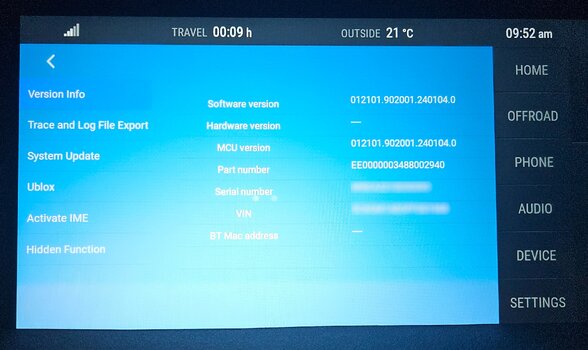
How to access to those screen? It looks very different from mine.My car is at 2031 days today, so subtract 9 (today) and it will have started at 2022.
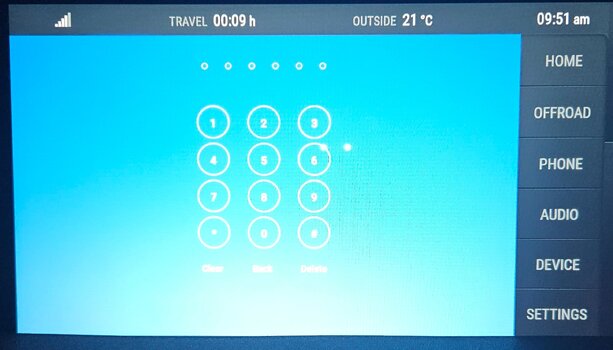
I wonder if there is anything in the "secret menu" or in the "hidden function" (as shown in the second image) that would give us the ability to reset the counter? Alternatively, we could get new firmware and upload it?


 lunduke.substack.com


Wow. Imagine trying to avoid a major accident and the car says nah you didn't signal first lets just hit that obstacle in the road instead.The ADAS on my Isuzu D-Max pickup with active lane keeping, collision avoidance, over speed warnings etc was not switchable when I bought the vehicle new. However complaints from owners on the often aggressive nature the vehicle would take control forced Isuzu to rethink and issue a return to dealer software upgrade that made the "safety" features switchable on and off via a button on the steering wheel. This had to be done at each startup.
I had occasions when the vehicle applied full emergency braking bringing the vehicle to a complete stop with lots of loud beeping and red led's flashing up on the windscreen after the ADAS camera/s detected a temporary roadside sign that it was not expecting. The action was totally out of the blue and nearly required a change of underwear.
Another example of a less than ideal situation happened when overtaking a truck on a 2 lane fast road, when level with the truck the D Max actively steered itself away from the truck on the left [actual hard input on the steering wheel care of electric steering] then detected the crash barrier close to the side of the road on the right, steered away from that, then steered away from the truck etc. This back and forth was hard to control and had I been towing a trailer would likely have resulted in dangerous snaking.
Oh and one more thing, with ADAS operative the vehicle didn't like you changing lanes without indicating first, the steering would actively try to keep you in lane. A good idea on busy roads but not really required when you are the only vehicle in sight.
The Ford Ranger pickup I had prior to the Isuzu was also ADAS equipped but was not as aggressive. My wife's current Hyundai also has active ADAS and is a PITA ....unless it's switched off.
Wow. Imagine trying to avoid a major accident and the car says nah you didn't signal first lets just hit that obstacle in the road instead.
Besides, he's got the brains of a dung beetle and the ambition of a French bureaucrat.
Bugs in the computer eh?
The story of the first "computer bug"... is a pile of lies.
A fun, endearing, delightful pile of lies.

I know they do stuff different in Alaska, but everywhere else had a very simple solution that worked a treat.Despite your ad hominem attack, sure, I can provide an example.
I worked as an air traffic controller for over 25 years at Anchorage ARTCC. By area, Anchorage ARTCC is the largest en route air traffic control facility in the world, with over 33 million square miles of airspace. Our airspace starts at the north pole and is bounded by Canada to the east, Russia and Japan to the west and the Pacific Ocean to the south. This facility controlls traffic in and out of all the airports in Alaska, but also controlls a very large portion of the air traffic flying between North America and Asia.
Up until the late 1990's, en route aircraft were separated vertically by 1,000' up to FL 290 and by 2,000' above that. Procedures - both domestic and by international treaty - dictated that eastbound aircraft would be assigned odd altitudes up to FL 290, then every 4,000' above that. So eastbound altitudes were FL 290, 330, 370, 410, 450 and so on. Westbound altitudes were even up to FL280, then FL 310, 350, 390, 430 and so on. This standard was established for and applied to all aircraft with altimetry certified for IFR under their country of registration's regulations. In other words, all aircraft had altimeters that were accurate enough that when a 2,000' vertical separation standard at FL 290 was applied, even the worst altimeter would not result in two aircraft colliding due to the lack of vertical separation. For an application of this standard, imagine an aircraft flying westbound at FL 310 passing directly below another aircraft flying opposite direction on the same route at FL 330. They'd be separated by a pressure altitude of 2,000'.
Beginning in the early 2000's, technology had advanced enough that precision altimetry, autopilot systems that hold a specified altitude and collision alerting systems (onboard aircraft) had advanced enough that 1,000' vertical separation criteria could be safely applied between properly equipped aircraft above FL 290. Take note of the caveat "properly equipped aircraft" because it's hugely important. Many areas of Anchorage ARTCC at the time had no radar (or other surveillance) and either poor on no direct radio communicatons between air traffic controllers and aircraft. One such area was a nonradar and no radio route segment where aircraft left Canada and flew into Alaska over Yakutat. Aircraft here flew for nearly an hour without any radar surveillance and no direct radio communication with air traffic control. Their position, route, assigned altitude, aircraft type and navigational equipment capabilities were recorded by hand on paper strips about 1-1/2" high and 7" long. As a controller at Anchorage ARTCC, I'd have a paper strip for each aircraft showing it's last position report in Canada and an estimate for when it should show up on my radar about an hour later over Yakutat. There might be 6 or 8 aircraft flightplanned east or west over Yakutat at any one time.
One auspicious day, the facility manager and the union president (representing the controllers) made the surpise announcement that we would now be separating aircraft on the route over Yakutat by a new standard called RVSM that allowed 1,000' vertical separation. This would allow many more aircraft to be on the same (or opposite route) since you could have one aircraft every 1,000' vertically instead of every 2,000'. This would alleviate congestion at airports as far east as New York and points farther west. "Oh, and by the way, you'll still need to apply 2,000' vertical separation to any aircraft not equipped to the RVSM standard," they said.
This announcement was met with consternation from a fair number of controllers. On midnight shifts, this route was worked by just one controller. In addition to this route, this controller would also be respsonsible for providing nonradar (no radar surveillance) approach control services in and out of at least three active airports in southeast Alaska as well as radar sequencing aircraft in and out of Anchorage from the east, all while monitoring/using more than a dozen VHF / UHF radio frequency pairs. In case it's not clear, that's a lot. And for a dirty little aviation secret, tired, sleep-deprived controllers and pilots working the midnight shift aren't the sharpest knife in the drawer, if you get my meaning.
The problem with this new procedure was that the east and west altitudes now worked out like this (I'll just go up to FL 450):
I've aligned the two rows to make it easier - can you see the problem here? That's right, some opposite-direction aircraft will be at the same altitude. In nonradar environments, and especially where there is no direct radio communications between a controller and a pilot, vertical separation is a CORNERSTONE of safe air traffic control. I can't stress this enough . . . vertical separation in these cases is like a commandment handed down from the air traffic control gods . . . you don't violate this tenet.Code:East - 290, 310, 330, 350, 370, 390, 410, 430, 450, ... and so on West - 300, 310, 320, 340, 350, 360, 380, 390, 400, 420, 440, ... and so on
But - and here's your example @Zimm , the facility chief and the union president told all of us controllers it would be very easy to avoid any problems. "Just look at the aircraft equipment suffix, then apply the appropriate vertical separation minima to each aircraft," they said. I and others pointed out that aiming opposite direction aircraft at each other at the same altitude on a route where there was no radar, no direct comm and nothing other than occasionally imperfect people to detect imminent collisions was extraordinarily dangerous. "Nope," they said, "it'll be easy."
I wrote a letter to my senator and explained that my employer was making a very foolish decision regarding the partial implementation of RVSM (the new 1,000' vertical separation criteria) and putting people's lives in danger. I wasn't fired only because my right to communicate with my senator was legally protected. The senator's staff wrote my employer and asked the very same people implenting this reckless program if there was any problem. Of course, they replied "No - all good here."
Within a year, a controller (not me) made a mistake and two opposite-direction aircraft at the same altitude near Yakutat and not within radar coverage had to take emergency evasive action to avoid a mid-air collision. Blame here was assigned to the controller for failing to identify the conflict. True . . . but entirely predictable. I wrote my senator again and said "Do you remember that bad thing I said would probably happen? Well, it happened. Will you do anything to help now?" I went on to explain that if those aircraft had actually collided, they and the nearly 1,000 passengers would have plunged into the dark, icy and completely inaccessible glaciers and ice fields north of Yakutat where Mt. St. Elias rises to 18,000 feet. Rescue, let alone recovery, would have been impossible . . . actually impossible. So the senator's staff again wrote the very same people responsible for implementing this program and asked if there was a problem. Of course, they replied "No - all good here."
There were several other close calls where controllers made "mistakes," although I'm not sure that's the right word when the game is rigged against you. Eventually, all aircraft were required to have RVSM equipment and the result was that no more aircraft were head on at the same altitude. East altitudes were all odd and west altitudes were all even once more.
@Zimm , I know you're on the edge of your seat by now. You might ask why the facility manager and union president were so eager to cast the solution to an extraordinarily complex problem to be something as simple as "Just look at the aircraft equipment suffix (you dummy), then apply the appropriate vertical separation minima to each aircraft." Well, it turns out RVSM had never been implemented in any United States air traffic facility before this, and reports suggest our manager wanted to be the first. He was, and it was quite a feather in his cap, no doubt affecting his career in a very positive and predictable manner. When the facility manager asked the controller's union president to agree to a new procedure for RVSM (required by the collective bargaining agreement), the president didn't want the people he represented to be cast as stupid or inept, so he agreed without the least hesitation.
So there you go. People suggesting simple solutions to complex problems often have a motivation other than the best outcome. The facility manager and union president survived their decision by sheer outhouse luck . . . not because they took the time to do the hard work of developing, testing and implementing what would have no doubt been a much more complex solution to a complex problem.
<end of fun and almost nearly very tragic story>
p.s., The senator in this story died about 10 years later . . . in an aircraft accident.