Register a free account today to become a member! Once signed in, you'll be able to contribute to the community by adding your own topics, posts, and connect with other members through your own private inbox! INEOS Agents, Dealers or Commercial vendors please use the contact us link at the bottom of the page.
Original Bolt 1
Length Station Dia. 1 Dia. 2 Notes
4.488 1 0.5430 closest to threads
2 0.5430 no significant difference Dia. 1 vs Dia. 2
3 0.5450
4 0.5460
5 0.5455
6 0.5460
7 0.5475 closest to head
Original Bolt 2
Length Station Dia. 1 Dia. 2 Notes
4.491 1 0.5420 0.5425 closest to threads
2 0.5460 0.5443
3 0.5450 0.5460
4 0.5445 0.5450
5 0.5450 0.5460
6 0.5455 0.5460
7 0.5465 0.5465 closest to head
New Bolt 1
Length Station Dia. 1 Dia. 2 Notes
4.467 1 0.5420 closest to threads
2 0.5425 no significant difference Dia. 1 vs Dia. 2
3 0.5440
4 0.5440
5 0.5450
6 0.5460
7 0.5465 closest to head
New Bolt 2
Length Station Dia. 1 Dia. 2 Notes
4.475 1 0.5420 closest to threads
2 0.5425 no significant difference Dia. 1 vs Dia. 2
3 0.5440
4 0.5440
5 0.5450
6 0.5460
7 0.5465 closest to head
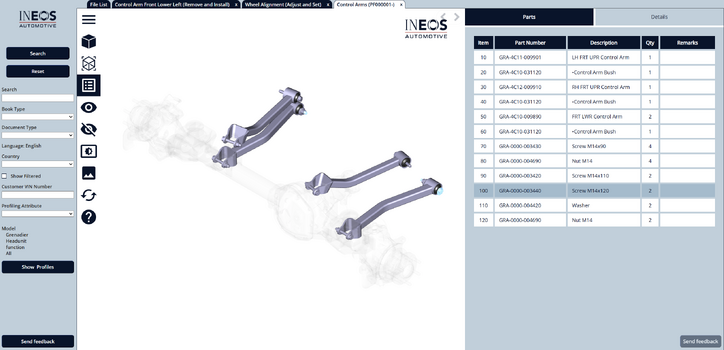
Whoa!I obtained replacement parts from the delaer and replaced the fasteners that secure the front axle lower control arm to the chassis. I took some measurements of the original bolts and the new ones. All dimensions are in inches.
<table>
<tr>
<th colspan="5">Original Bolt 1</th>
</tr>
<tr>
<th>Length</th>
<th>Station</th>
<th>Dia. 1</th>
<th>Dia. 2</th>
<th>Notes</th>
</tr>
<tr>
<td>4.488</td>
<td>1</td>
<td>0.5430</td>
<td></td>
<td>closest to threads</td>
</tr>
<tr>
<td></td>
<td>2</td>
<td>0.5430</td>
<td></td>
<td>no significant difference Dia. 1 vs Dia. 2</td>
</tr>
<tr>
<td></td>
<td>3</td>
<td>0.5450</td>
<td></td>
<td></td>
</tr>
<tr>
<td></td>
<td>4</td>
<td>0.5460</td>
<td></td>
<td></td>
</tr>
<tr>
<td></td>
<td>5</td>
<td>0.5455</td>
<td></td>
<td></td>
</tr>
<tr>
<td></td>
<td>6</td>
<td>0.5460</td>
<td></td>
<td></td>
</tr>
<tr>
<td></td>
<td>7</td>
<td>0.5475</td>
<td></td>
<td>closest to head</td>
</
<table>
<tr>
<th colspan="5">Original Bolt 2</th>
</tr>
<tr>
<th>Length</th>
<th>Station</th>
<th>Dia. 1</th>
<th>Dia. 2</th>
<th>Notes</th>
</tr>
<tr>
<td>4.491</td>
<td>1</td>
<td>0.5420</td>
<td>0.5425</td>
<td>closest to threads</td>
</tr>
<tr>
<td></td>
<td>2</td>
<td>0.5460</td>
<td>0.5443</td>
<td></td>
</tr>
<tr>
<td></td>
<td>3</td>
<td>0.5450</td>
<td>0.5460</td>
<td></td>
</tr>
<tr>
<td></td>
<td>4</td>
<td>0.5445</td>
<td>0.5450</td>
<td></td>
</tr>
<tr>
<td></td>
<td>5</td>
<td>0.5450</td>
<td>0.5460</td>
<td></td>
</tr>
<tr>
<td></td>
<td>6</td>
<td>0.5455</td>
<td>0.5460</td>
<td></td>
</tr>
<tr>
<td></td>
<td>7</td>
<td>0.5465</td>
<td>0.5465</td>
<td>closest to head</td>
</tr>
</table>
`
<table>
<tr>
<th colspan="5">New Bolt 1</th>
</tr>
<tr>
<th>Length</th>
<th>Station</th>
<th>Dia. 1</th>
<th>Dia. 2</th>
<th>Notes</th>
</tr>
<tr>
<td>4.467</td>
<td>1</td>
<td>0.5420</td>
<td></td>
<td>closest to threads</td>
</tr>
<tr>
<td></td>
<td>2</td>
<td>0.5425</td>
<td></td>
<td>no significant difference Dia. 1 vs Dia. 2</td>
</tr>
<tr>
<td></td>
<td>3</td>
<td>0.5440</td>
<td></td>
<td></td>
</tr>
<tr>
<td></td>
<td>4</td>
<td>0.5440</td>
<td></td>
<td></td>
</tr>
<tr>
<td></td>
<td>5</td>
<td>0.5450</td>
<td></td>
<td></td>
</tr>
<tr>
<td></td>
<td>6</td>
<td>0.5460</td>
<td></td>
<td></td>
</tr>
<tr>
<td></td>
<td>7</td
<table>
<thead>
<tr>
<th colspan="5">New Bolt 2</th>
</tr>
<tr>
<th>Length</th>
<th>Station</th>
<th>Dia. 1</th>
<th>Dia. 2</th>
<th>Notes</th>
</tr>
</thead>
<tbody>
<tr>
<td>4.475</td>
<td>1</td>
<td>0.5420</td>
<td></td>
<td>closest to threads</td>
</tr>
<tr>
<td></td>
<td>2</td>
<td>0.5425</td>
<td></td>
<td>no significant difference Dia. 1 vs Dia. 2</td>
</tr>
<tr>
<td></td>
<td>3</td>
<td>0.5440</td>
<td></td>
<td></td>
</tr>
<tr>
<td></td>
<td>4</td>
<td>0.5440</td>
<td></td>
<td></td>
</tr>
<tr>
<td></td>
<td>5</td>
<td>0.5450</td>
<td></td>
<td></td>
</tr>
<tr>
<td></td>
<td>6</td>
<td>0.5460</td>
<td></td>
<td></td>
</tr>
<tr>
<td></td>
<td>7</td>
<td>0.5465</td>
<td></td>
<td>closest to head</td>
</tr>
</tbody>
</table>
. . .
I want to personally apologize for the delay in my response; I didn't notice a system error that prevented me from seeing the follow-up sent by the engineers, and I only realized it today.
I'm really sorry for keeping you waiting for such a long time.
As for your inquiry, the engineers have confirmed that the official procedure is to apply 110Nm followed by the angle tightness.
They also asked me to express their gratitude for the effort you put into reviewing the process. They truly appreciate your work.
Thanks again for your patience and understanding.
If you need any further assistance or clarification, please feel free to reach out; I'm here to help.
Best Regards,
INEOS Automotive Customer Care Team
. . .
The parts listing does not designate the bolt in question (GRA-0000-003440) as single use for either the front or rear axle control arms. The confirmed torque spec of 110 Nm + 180° additional rotation seems to be very close to the proof load of a class 10.9 zinc plated M14 x 1.50 bolt. Can you confirm this part is intended to be reused?
An example of a part that is designated as single use is the propshaft screw set GRA-5D00-019750.
. . .
Following up on your enquiry, our Engineering team has confirmed that any bolt with a torque specification that includes an angle-tightening requirement should be considered single-use.
I hope this clarifies things. Please don’t hesitate to get in touch if you have any further questions or if there’s anything else we can assist you with.
I appreciate your continued replies, but I don't think we're communicating effectively. I want to be clear about why I keep pressing this issue: I'm genuinely concerned about the safe operation of my own vehicle. If you and your team are unwilling to continue this conversation, please let me know and I'll stop pursuing the matter.
If you are willing to try to resolve the confusion, I'd ask that you pass these points along to your engineers for consideration.
1. The torque specification appears to drive the bolt far beyond yield.
The torque specification for part # GRA-0000-003440 (110 Nm + 180° advance) appears to take the bolt significantly past its yield point. Based on standard Class 10.9 calculations, yield occurs at approximately 110 Nm + 69° of advance. The specification calls for 180° of advance, which is approximately 2.6 times the angular advance required to reach yield.
If the intent is a torque-to-yield procedure, driving the bolt 2.6× past the yield angle serves no engineering purpose and raises legitimate safety concerns. If the intent is not to yield the bolt, then the specification needs to be re-examined, because by any standard Class 10.9 analysis, that's what it does.
2. A torque-to-yield fastener on an adjustable suspension component is contradictory.
A torque-to-yield bolt is a single-use fastener – it must be replaced once it has been torqued to yield. Yet this bolt secures the control arm to the chassis and must be loosened and re-torqued each time the front caster is adjusted. The workshop manual (steps 22–25) reflects this contradiction directly:
![]()
There is no remove-and-replace instruction anywhere in this procedure. In practice, caster adjustment often requires multiple loosening and re-torquing cycles in a single session to dial in the correct geometry. If this is truly a torque-to-yield specification, the fastener would need to be replaced after each torquing cycle – which is neither stated in the manual nor operationally reasonable.
3. The Class 10.9 designation has published, well-understood properties – and none of your responses have addressed the apparent contradiction.
I understand that your engineers likely use sophisticated modelling software and may even have empirical test data. I'm not dismissing that. But the fastener is marked Class 10.9, and that designation carries defined mechanical properties under ISO 898-1 – yield strength, proof load, tensile stress area, and the relationships between applied torque, bolt tension, and angular advance under elastic and plastic deformation. These are not proprietary calculations; they are published standards that apply to any bolt of that specification regardless of manufacturer.
My concern is straightforward: under standard Class 10.9 analysis, your specification drives this bolt well past its elastic limit. None of the responses I've received so far have addressed that specific point. I'm not asking you to validate my calculations – I'm asking your engineers to re-examine (and if willing, to explain) how their specification is consistent with the known mechanical properties of a Class 10.9 fastener. If there's a reason this bolt behaves differently from what the standard predicts, I'd genuinely like to understand it.
I've attached a revised and more accurate version of the calculations that inform my concerns. A sensitivity analysis shows that across a wide range of reasonable input values – Young's modulus, thread friction coefficient (µ_t), nut bearing friction coefficient (µ_n), and effective bolt length – the bolt is driven well beyond yield when the current torque procedure is applied.
Glen