The Grenadier Forum

Register a free account today to become a member! Once signed in, you'll be able to contribute to the community by adding your own topics, posts, and connect with other members through your own private inbox! INEOS Agents, Dealers or Commercial vendors please use the contact us link at the bottom of the page.

Front Suspension Lower Control Arm Torque Specs

Glen

Grenadier Owner
Lifetime Supporter
Local time
3:01 PM
Joined
Oct 29, 2025
Messages
86
Location
Golden, CO
I've found what appears to be either conflicting or ambiguous information in the workshop manual regarding the torque specification for the front lower control arm bolt and nut.

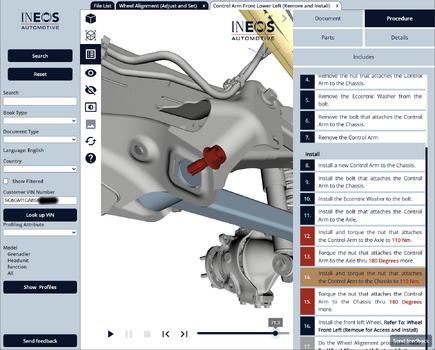
LOWER CONTROL ARM - REMOVE AND REPLACE
The procedure for removing and replacing the front lower control arm is found at
Workshop Manual | Station Wagon and Utility Wagon | 4. Steering and Suspension |
4C. Front Suspension | Control arm Front Lower Left (Remove and Install)

This document includes the following instructions:
14. Install and torque the nut that attaches the Control Arm to the Chassis to 110 Nm.
15. Torque the nut that attaches the Control Arm to the Chassis thru
180 degrees more.

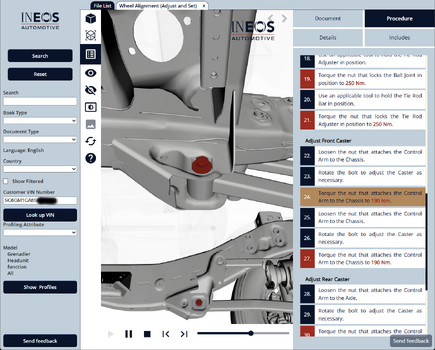
WHEEL ALIGNMENT
The procedure for aligning the front wheels is found at
Workshop Manual | Station Wagon and Utility Wagon | 4. Steering and Suspension |
4B. Steering | Wheel Alignment (Adjust and Set)

This document includes the following instructions:
27. Torque the nut that attaches the Control Arm to the Chassis to 190 Nm.

DISCUSSION
The problem I see here is that the first procedure [110 Nm then 180° more] results in a far higher torque than 190 Nm. I had to use my impact wrench to achieve this spec . . . my WAG is it's in the 350 - 475 Nm range.

The only explanation I can think of is that the spec of [110 Nm then 180° more] might only be intended for the initial construction at the factory. The intent might be to compress the underlying steel structure ONE TIME with this procedure, then for every time thereafter - for the life of the vehicle - that the 190 Nm specification would apply.

I adjusted the caster on my vehicle recently and had only found the remove and replace procedure [110 Nm then 180° more], so my lower control arm fasteners are currently sitting at the amount of stretch resulting from that procedure. The bolt ought to be able to handle this amount of stretch without plastic deformation since the alignment procedure does not say to replace the bolt (a torque to yield bolt would need to be replaced any time the joint was loosened, e.g., during an alignment).

I'm inclined to remove the nut and bolt and inspect (with a micrometer) for necking that might indicate an overtorque condition, and if all is well, replace the fasteners and torque to 190 NM.

Any ideas on what Ineos intended here?

I submitted feedback through the workshop manual site requesting clarification, but have not received a reply after more than two weeks. I also sent an email today to customerservice@ineosgrenadier.com asking with whom I can converse about this subject. I'll update this thread with any replies.
 

Attachments
  • alignment.png
    alignment.png
    475.5 KB · Views: 16
  • control_arm.png
    control_arm.png
    448.3 KB · Views: 16
Last edited:
I thought it was suggested that these were one time use bolts. Did I make that up? I don't treat them as such, but I swear I heard that.
 
M14.
There was a torque check campaign on those bolts last year.

IAMWO002310-LONGITUDINAL ARM TORQUE CHK
You'd be brave to take M14 up to 300Nm. My 928 has an M16 that gets 210.
190 would seem about right .Our steelies get 180.
 
Can ypu post the whole document? Does it specify a torque value or procedure?
I don't have it. I'm referencing the MWO # from a service invoice.
I posted a bit more about it here last August.
 
Last edited:
You'd be brave to take M14 up to 300Nm. My 928 has an M16 that gets 210.
190 would seem about right .Our steelies get 180.
350-475nm if correct seems well toight for an m14
 
I thought it was suggested that these were one time use bolts. Did I make that up? I don't treat them as such, but I swear I heard that.
Good memory. I posted that over in this thread based on information given to me by my agent.

But now I have access to the documentation portal I cannot see anything about using a new bolt during installation of the control arms, nor is there a single-use annotation on those parts in the IPC (unlike the torque to yield driveshaft bolts which are marked as single-use in the IPC). I suspect either the Torque Check MWO advised not to re-use bolts that failed the check or my agent assumed they are single use because of the torque to yield method used.

Needing to replace the bolts each time seems highly unlikely. That would require a new set of bolts at the frame end every time a wheel alignment was done. But torque to yield stretches the bolt so there is something amiss here.
 
….
Needing to replace the bolts each time seems highly unlikely. That would require a new set of bolts at the frame end every time a wheel alignment was done. But torque to yield stretches the bolt so there is something amiss here.
My thoughts exactly. I do my own alignments and it’s not uncommon to measure, loosen, adjust, tighten, measure AND repeat at least one more time to get as close to the spec as possible. Having to replace the fastener every time would only give you one chance at setting the spec . . . not very practicable in my experience.
 
I received a reply from Ineos this morning where they asked for more information so they can route my inquiry to the right department. Hopefully they get back to me with a prompt response. I'm not too keen on driving around with bolts stretched to yield if they weren't intended to be tightened that way.

This is largely a repeat of my original post, but here's what I sent to Ineos:

Ineos,

Thanks for your quick reply.

I believe this may be a SAFETY ISSUE, so I hope you will be able to elevate it for a quick resolution.

I've found what appears to be either conflicting or ambiguous information in the workshop manual regarding the torque specification for the bolt connecting the front lower control arm to the frame. This is the bolt with eccentrics for adjusting caster. My inquiry is limited to this particular fastener because I have followed one procedure in the manual and later found another conflicting procedure. But this conflict also appears for similar fasteners in other positions for both the front and rear axles, so that'll need to be addressed at some point too.

LOWER CONTROL ARM - REMOVE AND REPLACE
The procedure for removing and replacing the front lower control arm is found at
Workshop Manual | Station Wagon and Utility Wagon | 4. Steering and Suspension |
4C. Front Suspension | Control arm Front Lower Left (Remove and Install)

This document includes the following instructions:
14. Install and torque the nut that attaches the Control Arm to the Chassis to 110 Nm.
15. Torque the nut that attaches the Control Arm to the Chassis thru 180 degrees more.

WHEEL ALIGNMENT
The procedure for aligning the front wheels is found at
Workshop Manual | Station Wagon and Utility Wagon | 4. Steering and Suspension |
4B. Steering | Wheel Alignment (Adjust and Set)

This document includes the following instructions:
27. Torque the nut that attaches the Control Arm to the Chassis to 190 Nm.

DISCUSSION
The problem I see here is that the LOWER CONTROL ARM procedure [110 Nm then 180° more] looks like a torque-to-yield procedure that would require the bolt to be replaced every time it was loosened. I don't find any mention of replacing this bolt in the workshop manual. The 190 Nm specification in the WHEEL ALIGNMENT procedure is in the range of what I would expect for an M14 bolt intended to be reused after loosening. Other fasteners at different positions on the front and rear axles also specify a torque-to-yield procedure, but there is no mention of replacing the fastener upon loosening. (Example: the bolt securing the front control arm to the axle is also tightened to 110 Nm then 180° more.)

I adjusted the caster on my vehicle recently and - at that time - had only found the lower control arm procedure [110 Nm then 180° more] in the workshop manual. So my lower control arm fasteners are currently sitting at the amount of stretch resulting from that procedure. I had to use my impact wrench to achieve this spec . . . my guess is it results in a torque value in the range of 350 - 475 Nm, which would almost certainly exceed the elastic limit of the bolt.

INQUIRY
It seems unlikely that both procedures are correct. Should I replace the bolts connecting my front axle lower control arm to the frame? What procedure should I use to tighten them? Should they be replaced after every loosening?

I have attached screenshots of two sections from the workshop manual showing the current procedures in question (alignment.png and control_arm.png).

As a safety measure, I'm inclined to stop operating my vehicle until you are able to resolve this problem, so your prompt attention will be very much appreciated.

Glen
 
Good memory. I posted that over in this thread based on information given to me by my agent.

But now I have access to the documentation portal I cannot see anything about using a new bolt during installation of the control arms, nor is there a single-use annotation on those parts in the IPC (unlike the torque to yield driveshaft bolts which are marked as single-use in the IPC). I suspect either the Torque Check MWO advised not to re-use bolts that failed the check or my agent assumed they are single use because of the torque to yield method used.

Needing to replace the bolts each time seems highly unlikely. That would require a new set of bolts at the frame end every time a wheel alignment was done. But torque to yield stretches the bolt so there is something amiss here.
What or where is the IPC?

The speed of accessing the workshop manual directly led to the problem I've encountered - I'd normally read (or at least scan) the whole manual to discover problems just like this. But with each page taking 60 to 120 seconds to load, that would be a very laborious and time-consuming task. I'll be mentioning this to Ineos in future correspondence.
 
Last edited:
You'd be brave to take M14 up to 300Nm. My 928 has an M16 that gets 210.
190 would seem about right .Our steelies get 180.
The M16 bolt securing the pulleys on the nose of my 968 crankshaft also gets 210 Nm - lots of shared engine parts :) I was surprised that bolt wasn't torque to yield as German engineers seem to like that on crankshafts.
The first time I removed the crank bolt on my 968 I bent a 1/2" drive breaker bar (a SnapOn no less). That's what prompted me to first acquire a 3/4" drive breaker bar and sockets. That was a great example of why "checking the torque" of a fastener is something of a red herring. Porsche installed the M16 crank bolt with 210 Nm of torque, but it took approximately 400 - 500 Nm to remove it (albeit after 10 years of service). You can't accurately "check" the torque of an installed fastener by putting a torque wrench on it and trying to tighten or loosen it. Unfortunately, the only accurate way to ensure an installed fastener is torqued to the correct value is to loosen it and then re-torque. This premise has been proven over and over - hopefully this statement doesn't ignite a needless debate.
 
Last edited:
My thoughts exactly. I do my own alignments and it’s not uncommon to measure, loosen, adjust, tighten, measure AND repeat at least one more time to get as close to the spec as possible. Having to replace the fastener every time would only give you one chance at setting the spec . . . not very practicable in my experience.

Ok. I have learned something today. Torque to angle and torque to yield are not the same thing although the method is similar.

Torque to angle stretches the bolt but not beyond the point of yield (the plastic point). This method is also known as torque + angle. Torque to angle fasteners are reusable but should be inspected before each use. The OEM may still specify replacement depending on the application.

Torque to yield fasteners are single use because the final torque permanently stretches the fastener.

This shop press article is informative. It even mentions control arm bolts.
 
What or where is the IPC?

The speed of accessing the workshop manual directly led to the problem I've encountered - I'd normally read (or at least scan) the whole manual to discover problems just like this. But with each page taking 60 to 120 seconds to load, that would be a very laborious and time-consuming task. I'll be mentioning this to Ineos in future correspondence.
Illustrated Parts Catalog. IA call it the Grenadier Parts Catalog.
 
Ok. I have learned something today. Torque to angle and torque to yield are not the same thing although the method is similar.
I don’t think you can tell if a procedure specifying base torque plus an additional angle will result in plastic deformation (torque to yield) or only involves elastic deformation.

The result changes in relation to the scale of the additional rotation. And that result would have to be determined by testing of a specific bolt size, grade, a particular joint and a particular bolt manufacturer. There are too many variables there to preclude specific testing.
 
The Porsche bolt is one time use torque to yield. I removed it with a long piece if pipe over the breaker bar - and carefully shielded the alloy wings 🧐
And I borrow a truck torque wrench to tighten.
 
I don’t think you can tell if a procedure specifying base torque plus an additional angle will result in plastic deformation (torque to yield) or only involves elastic deformation.

The result changes in relation to the scale of the additional rotation. And that result would have to be determined by testing of a specific bolt size, grade, a particular joint and a particular bolt manufacturer. There are too many variables there to preclude specific testing.

Yes, and I am assuming that is exactly what IA (or Magna) have done here. I'm not invested enough to do any testing, but it occurred to me that 190Nm + 180 degrees might not stretch a grade 10.9 or 12.9 M14 bolt into the plastic zone so I did some reading. The other hint was there is no mandatory replacement of the bolt so it's either a process error or not torque to yield.

The oddball is the wheel alignment torque.
Be interesting to hear what IA say in their response.
 
Back
Top Bottom