The Grenadier Forum

Register a free account today to become a member! Once signed in, you'll be able to contribute to the community by adding your own topics, posts, and connect with other members through your own private inbox! INEOS Agents, Dealers or Commercial vendors please use the contact us link at the bottom of the page.

Front Drive Shaft Update

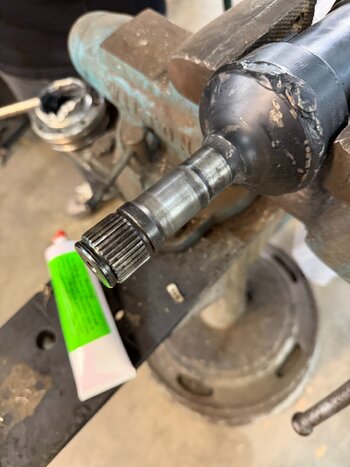
View attachment 7922481This is what the grooves under the CV joints look like. I hadn't noticed them before. To loosen the CV joints, a wedge-shaped tool would be ideal, such as a thick nail or a sharpened screwdriver that you drive into the slot with a hammer.
I recognise that photo....!
 
There's a good reason why not all the interesting photos can be of my own car; otherwise, I'd have a real lemon.
So, if I find good photos in the forum that might be of technical interest someday, I save them. ECrider, if these are your photos, I hope you don't mind that they were used for the benefit of us all.
 
There's a good reason why not all the interesting photos can be of my own car; otherwise, I'd have a real lemon.
So, if I find good photos in the forum that might be of technical interest someday, I save them. ECrider, if these are your photos, I hope you don't mind that they were used for the benefit of us all.
of course not chap. tks posting.
 
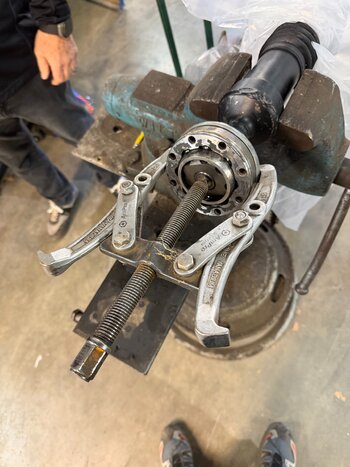
This tool might be a helpful aid for removing a damaged drive shaft. It is designed to fit precisely into the small groove behind the CV joint, allowing you to easily pry the joint out. It is compact and can be carried with you at all times. It is from Milwaukee.
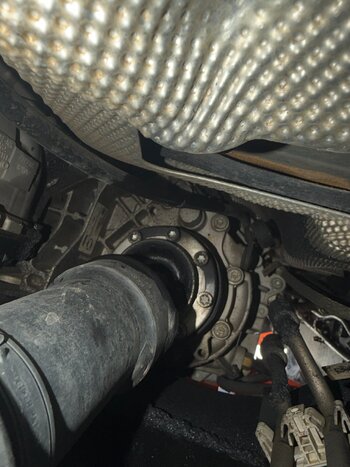
The limited collective experience does not suggest any problems getting the front CV joint out of the pinion cup - but the rear from the transfer case. And there's no groove to stick any aid to.
 
The limited collective experience does not suggest any problems getting the front CV joint out of the pinion cup - but the rear from the transfer case. And there's no groove to stick any aid to.
The pinion and the T-case flanges are wildly different. I assume the pinion flange is made by Cararro and the T-case flange; who knows. But the T-case flange is coated and the pinion is not. There is clearly some galvanic corrosion or something by going on at the T-case.

A small or large pick is not going to get the T-case loose regardless. The T-case side can require some real force. But it's all totally doable even with the crossmember in place.
 
I still have the loaner - drive shaft not yet replaced nor the turn signal stalk. I went back into the dealer because I wanted to get a bunch of fishing equipment out of the back of my Grenadier. Had a chance to talk to the service tech - he proposed an interesting theory, purely based on anecdotal evidence talking to other service techs at other dealers in the US. He was wondering whether the rubber in the boot was susceptible to either 1)cold temperatures or 2)road salt treatment. He just had a notion that dealers in colder climates might be seeing more failures.

I’m wondering whether we could put together a spreadsheet where everyone could enter their info - this is not just for drive shaft failure, but also boot tears:
username
Country
State/Province
Lift (y/n)
Approximate date failure discovered
Approximate mileage at failure
Notes - e.g member located in Texas, but spends a lot of time with their Grenadier up at Tahoe

@Stu_Barnes @Krabby - would something like this be possible or do we already have something like it? It could be helpful for IA. Perhaps this has already been covered and I just wasn’t paying attention, like the self-righteous Pharisee - “Lord, thank you that I am not like these other sinners with suspension lifts, and have not justly incurred your wrath for violating the design specs.”
 
I still have the loaner - drive shaft not yet replaced nor the turn signal stalk. I went back into the dealer because I wanted to get a bunch of fishing equipment out of the back of my Grenadier. Had a chance to talk to the service tech - he proposed an interesting theory, purely based on anecdotal evidence talking to other service techs at other dealers in the US. He was wondering whether the rubber in the boot was susceptible to either 1)cold temperatures or 2)road salt treatment. He just had a notion that dealers in colder climates might be seeing more failures.

I’m wondering whether we could put together a spreadsheet where everyone could enter their info - this is not just for drive shaft failure, but also boot tears:
username
Country
State/Province
Lift (y/n)
Approximate date failure discovered
Approximate mileage at failure
Notes - e.g member located in Texas, but spends a lot of time with their Grenadier up at Tahoe

@Stu_Barnes @Krabby - would something like this be possible or do we already have something like it? It could be helpful for IA. Perhaps this has already been covered and I just wasn’t paying attention, like the self-righteous Pharisee - “Lord, thank you that I am not like these other sinners with suspension lifts, and have not justly incurred your wrath for violating the design specs.”
So what's the explanation for the mass numbers down in the south where we don't even use salt.

I'm certain salt accelerates the failure but the base mechanism Is the same.
 
So what's the explanation for the mass numbers down in the south where we don't even use salt.

I'm certain salt accelerates the failure but the base mechanism Is the same.
He was just going on anecdotal evidence - what would be interesting would be to see failures WITHOUT lift in different climates. He didn’t know for certain that the South had a lower relative number of failures.
 
I still have the loaner - drive shaft not yet replaced nor the turn signal stalk. I went back into the dealer because I wanted to get a bunch of fishing equipment out of the back of my Grenadier. Had a chance to talk to the service tech - he proposed an interesting theory, purely based on anecdotal evidence talking to other service techs at other dealers in the US. He was wondering whether the rubber in the boot was susceptible to either 1)cold temperatures or 2)road salt treatment. He just had a notion that dealers in colder climates might be seeing more failures.

I’m wondering whether we could put together a spreadsheet where everyone could enter their info - this is not just for drive shaft failure, but also boot tears:
username
Country
State/Province
Lift (y/n)
Approximate date failure discovered
Approximate mileage at failure
Notes - e.g member located in Texas, but spends a lot of time with their Grenadier up at Tahoe

@Stu_Barnes @Krabby - would something like this be possible or do we already have something like it? It could be helpful for IA. Perhaps this has already been covered and I just wasn’t paying attention, like the self-righteous Pharisee - “Lord, thank you that I am not like these other sinners with suspension lifts, and have not justly incurred your wrath for violating the design specs.”
This is a good conversation. I look at lifting my Grenadier with the Metal Cloak 2.5" lift, but I don't want the drive shaft headache. But still tempting.
It is unlikely that Ineos would ever share their data, to this forum is probably the best available. And Facebook.
I like your poll, be a bit more specific with the failure (mileage if stock, mileage after lift if not). But this is the only way to get data now. Maybe to get more data, the broadest reach would be the "Ineos Grenadier Owners Club" with 43,000 members.

I asked Claude to research data across The Forum and Facebook, acknowledging duplicate data. This is the result of the IA analysis. The first .pdf is The Forum only, V2 includes Facebook and prediction.

My conclusion: the risk is real, but it is 1.5%-3% of moderately lifted at this time. I'm not in a hurry, I would like to get more data.


Screenshot 2026-03-02 at 7.17.15 PM.png
 

Attachments

Back
Top Bottom