The Grenadier Forum

Register a free account today to become a member! Once signed in, you'll be able to contribute to the community by adding your own topics, posts, and connect with other members through your own private inbox! INEOS Agents, Dealers or Commercial vendors please use the contact us link at the bottom of the page.

Front Drive Shaft Update

High RPMs occur because of high speeds; it’s all connected. The driveshaft rotates four times when the tire rotates once.
Maybe I’m missing something but the way I think about it, you can redline in 1st gear, like you can in 7th…but your speed (MPH/KPH) will be drastically different. If the vehicle only had one gear, I’d agree that the higher the RPM, the higher the velocity…..assuming there’s adequate traction.
 
The engine speed has nothing to do with the rotational speed of the shaft and the tires. The transmission separates these two from each other. The rotational speed of the tires and the shaft are always in a fixed relationship.
 
Are our Euro friends (autobahn/autostrada) who routinely travel quickly (up to 160 km/hr) having propshaft dramas?
 
I never drive 160 km/h with the car. Otherwise, the boot would probably wear out even faster.


A week ago, I was at Manthey/Räder Motorsport and had the front differential raised as much as possible to improve the angle of the shaft. The car drives better than before with the new setup.


I’m curious to see whether this will have a positive effect on the lifespan of the boot.
 
I never drive 160 km/h with the car. Otherwise, the boot would probably wear out even faster.


A week ago, I was at Manthey/Räder Motorsport and had the front differential raised as much as possible to improve the angle of the shaft. The car drives better than before with the new setup.


I’m curious to see whether this will have a positive effect on the lifespan of the boot.
Propshafdt speed thoughts.
I'm not sure of the failure rate according to country/highway speeds.
In Australia the speed limit is 110km/hr (except one state = 130 km/hr, only a small % of Grenadiers travel here) NA and Europe you travel faster, up to 160km/hr.
Lifts are one thing, speeds are another.
 
It isn't the proper solution to the issue at hand, but a driveshaft vibration damper could be made quite easily. Imagine a toroidal mass attached to the driveshaft yoke with a rubber sheet and a flat flange - on the transfer case side, it won't interfere with anything.
You inspired me to tinker with passive/active NVH suppression in a Gren.
Driveline dampers have been used over the years on front or mid mount engine buses and some trucks They're like a viscous damper on an engine.
bus-driveline.webp
 
"Raising the differential in its angle'" to accommodate a 30mm lift and reduce the drive shaft angle implies to me that the diff was essentially rotated forwards at the top via caster settings.
By reducing the drive angle you induce  negative caster.
I can't reconcile how this improved the driving experience. I'd have thought the straight line stability would deteriorate. 🤔
 
The differential is adjusted to its maximum angle so that the angle of the driveshaft becomes flatter. I checked that myself. According to the report, it is now set to 0°. I’m absolutely satisfied and would recommend it to anyone. How it will affect the CV boot remains to be seen.
 
Driveline dampers have been used over the years on front or mid mount engine buses and some trucks They're like a viscous damper on an engine.
View attachment 7921316
My reading says the best giubo dampers can flex up to 4.5 degrees without tearing.
What angles are we looking at with full articulation on a Grenadier?
 
My reading says the best giubo dampers can flex up to 4.5 degrees without tearing.
What angles are we looking at with full articulation on a Grenadier?
The dampers are just that, dampers. They absorb harmonics only. They are not part of the power transmission itself.
 
The dampers are just that, dampers. They absorb harmonics only. They are not part of the power transmission itself.
So whete are we thinking to mount them on the redesigned Ineos propshaft? Seems like a complicated solution to a secondary problem to the primary problem🫠
I do know about propshaft dampers and yes they do flex with age! - replaced them on two 60s Benzes in my stable, and the old Disco.
 
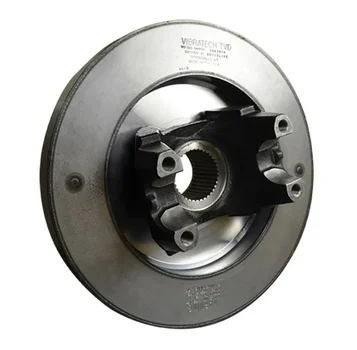
My 2006 Jeep Wrangler has a mass damper mounted at the transfer case output for the rear axle. There is no rubber or other flexible material, it is purely a metal ring designed to absorb harmonics. This is an original OEM part, it was not added as an aftermarket item. That said, it is always preferable to align a u-joint style drive shaft such that the natural harmonics are minimized as much as possible. On my Jeep this is easily done. On the axle side with a single u-joint the shaft is set perpendicular to the diff, 0° to the pinion . The double cardan at the transfer case is at less than 10°. This is the ideal setup for this style of shaft and it runs smoothly to a point, but a CV Rzeppa style shaft will always be naturally smoother. On the Grenadier where by the front shaft joint angles cannot be optimized because of the need for steering caster the harmonics are unavoidable and a damper will only reduce the perceived magnitude of these harmonics. And it is unlikely to reduce the perceived harmonics of a u-joint style shaft to a point which most owners would find acceptable. It would also do nothing regarding the reduced service life of the u-joints because of the harmonics.

The damper in my Jeep is shown in the photo.

mop-05017819aa_hl_xl.jpg
 
Last edited:
So whete are we thinking to mount them on the redesigned Ineos propshaft? Seems like a complicated solution to a secondary problem to the primary problem🫠
I do know about propshaft dampers and yes they do flex with age! - replaced them on two 60s Benzes in my stable, and the old Disco.
I am sure you have replaced Rotoflex joints, not dampers. Benz and Land Rover and others used these rubber donuts as a substitute for a proper CV joint.
 
I am sure you have replaced Rotoflex joints, not dampers. Benz and Land Rover and others used these rubber donuts as a substitute for a proper CV joint.
Are they not harmonic dampers?
 
Back
Top Bottom