The Grenadier Forum

Register a free account today to become a member! Once signed in, you'll be able to contribute to the community by adding your own topics, posts, and connect with other members through your own private inbox! INEOS Agents, Dealers or Commercial vendors please use the contact us link at the bottom of the page.

Front Drive Shaft Update

I need to get the vehicle on a lift to see if the extra extended length of the King shocks will just doom any boot in the future.

FWIW the Fox offering does not seem to have an extended length longer than the factory shock, which seems to act as the limiting strap in this design.
Or keep the kings and figure out how to install a limiting strap.
 
The shaft on my lifted truck gives me a 15° angle at the diff and I believe it was 16.5° at the T-case.

The Tera joint will cross reference to the exact Dana part I am certain. It's not just a happy coincidence they fit, it's the exact joint just aftermarket. There is not hi big special about the Tera joint, it's not higher angle or anything, it's just another joint.

I have had Ineos factory joints fall off and some that took a slight beating to get off. Non have shown anything remotely close to an interference fit that you are looking for.

Thanks for the measurements. 2.5" lift right?

I don't know, but my gearbox-side cv joint came out with a puller and went in with a big hammer.

I'm still convinced that Dana's driveshaft tolerances are lower than Tefaflex's and that they save the c-clip..
 
I need to get the vehicle on a lift to see if the extra extended length of the King shocks will just doom any boot in the future.

FWIW the Fox offering does not seem to have an extended length longer than the factory shock, which seems to act as the limiting strap in this design.
I have kings, and I own a lift. I can tell you that the pinch of the boot is not much more than factory length. I can also tell you that the boot gets just enough pinch even with factory shocks to cause failure. You would need to likely limit travel from stock by about 1.5-2" to prevent boot failure from excessive boot angle.
 
I need to get the vehicle on a lift to see if the extra extended length of the King shocks will just doom any boot in the future.

FWIW the Fox offering does not seem to have an extended length longer than the factory shock, which seems to act as the limiting strap in this design.
I have the 2.5 Eibach lift with 315/70/17's with Fox 2.5's and my boot ripped!
 
Thanks for the measurements. 2.5" lift right?

I don't know, but my gearbox-side cv joint came out with a puller and went in with a big hammer.

I'm still convinced that Dana's driveshaft tolerances are lower than Tefaflex's and that they save the c-clip..
Yes 2.5"

We had an Ineos joint basically fall off. It had only a minor tear in it somit hadn't lost all grease etc. the joint was still in good shape.
 
Ignoring caster, is there a rough estimate on how many degrees the pinion would need to be rotated up in order to eliminate pinching of the boot at the transfer case? If say one were to attempt a cut and turn or have a custom axle assembly made.

With the OEM axle I currently have 2.7°+ degrees of caster. Would reducing this to 1.5° make any meaningful difference in the life of the CV boot.
 
Ignoring caster, is there a rough estimate on how many degrees the pinion would need to be rotated up in order to eliminate pinching of the boot at the transfer case? If say one were to attempt a cut and turn or have a custom axle assembly made.

With the OEM axle I currently have 2.7°+ degrees of caster. Would reducing this to 1.5° make any meaningful difference in the life of the CV boot.
You would have to eliminate all caster or more to get things right. I just don't know how Ineos got it so wrong. Unless it was a spec from Cararro they were adhering to.
 
You would have to eliminate all caster or more to get things right. I just don't know how Ineos got it so wrong. Unless it was a spec from Cararro they were adhering to.
There is a difference between getting it right and making it better. Is 1° is enough to increase boot life? It certainly will not solve the problem entirely but it would be great to get more mileage out of each boot before failure. I will give up a bit of straight line stability and return to center if I can more confidently get 10K miles out of the boot at the transfer case.

Regarding a cut and turned axle or a replacement assembly what would be the optimal change in pinion angle. In my mind you need 3 degrees of pinon rotation just to get the kingpin caster angle to a target of around 5°. How much more would be needed to eliminate the boot problem. Is it another 3° for a total rotation of 6° or would the required change be 8° or more in total?

I bring this up because it is clear the only true solution is a revised axle assembly with higher pinion rotation or alternatively a high pinion differential housing. But I have yet to see any discussion that quantifies the amount of change actually required.
 
Last edited:
I have kings, and I own a lift. I can tell you that the pinch of the boot is not much more than factory length. I can also tell you that the boot gets just enough pinch even with factory shocks to cause failure. You would need to likely limit travel from stock by about 1.5-2" to prevent boot failure from excessive boot angle.
It would be very bad news if the boot is pinched with the stock length shock.
 
The boot is certainly getting stressed with the OEM shock length otherwise what would explain the many documented boot failures on unmodified rigs.
1767662456475.png


I will post this chart you made again as it has been really helpful for me. FWIW the Agile Fox shocks have a nearly identical extension and compression length as the stock SACHS shocks.
 
There is a difference between getting it right and making it better. Is 1° is enough to increase boot life? It certainly will not solve the problem entirely but it would be great to get more mileage out of each boot before failure. I will give up a bit of straight line stability and return to center if I can more confidently get 10K miles out of the boot at the transfer case.

Regarding a cut and turned axle or a replacement assembly what would be the optimal change in pinion angle. In my mind you need 3 degrees of pinon rotation just to get the kingpin caster angle to a target of around 5°. How much more would be needed to eliminate the boot problem. Is it another 3° for a total rotation of 6° or would the required change be 8° or more in total?

I bring this up because it is clear the only true solution is a revised axle assembly with higher pinion rotation or alternatively a high pinion differential housing. But I have yet to see any discussion that quantifies the amount of change actually required.
Racking your caster as low as possible will certainly extend the life. Could extend it considerably too. But a drive shaft should last 100k plus. Hell it really should pull 200k with ease. No minor change will fix that. Nor will it appreciably change the cost per mile much. Until a solution has been found your best to change every 7-10k miles and just inspect inspect inspect. No need to suffer with even more poor handling just to save a buck by getting a couple few thousand miles.

No discussion has been had about the amounts needed because there is no way of achieving it yet. But ideally you will want to point the pinion directly at the T-case flange or even up a degree or two. So that's about 15° up. You could certainly be a bit less overkill and roll the pinion up about 8-10° and probably achieve what you want, but if your cutting and turning why not go full hog.

Well the answer to that might be that the suspension geometry will start to get funky. But that could be solvable too. Lots to talk about beyond just a few degrees of pinion angle.
 
Just to get better longevity.
Would added bump stops help to prevent extra sag!
Example: what you lift add the bump stop length to match?
I’m only thinking of the 1.2” springs for front/ Leveling.
It's extension that's the problem not compression. So taller bump stops won't help anything.
 
My 2 cents:

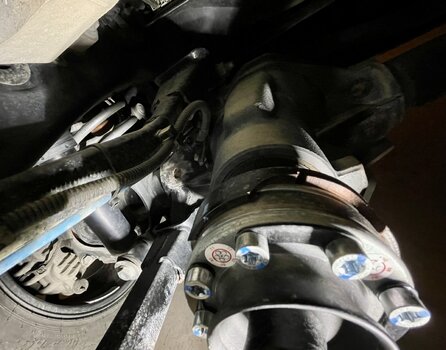
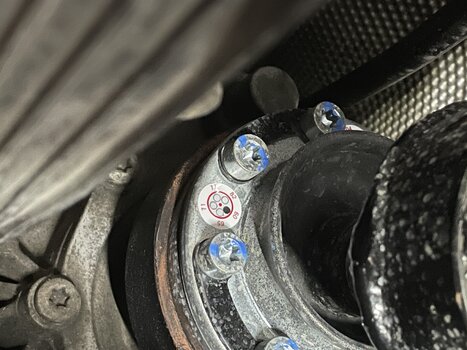
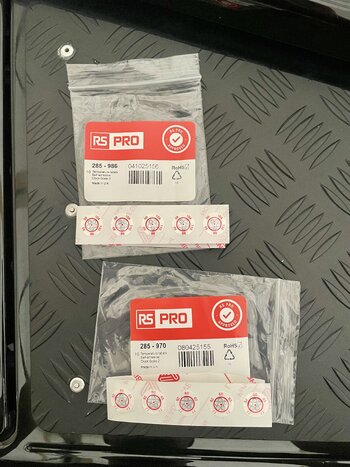
Today I mounted irreversible heat-seals on both four CV joints to see how hot they get. After about three hours on the highway at about 100 km/h, this is the result: front CV joint on the transfer side 60°, all the other three below.
 

Attachments

  • IMG_7449.jpeg
    IMG_7449.jpeg
    3.4 MB · Views: 64
  • IMG_7448.jpeg
    IMG_7448.jpeg
    3.3 MB · Views: 64
  • IMG_7422.jpeg
    IMG_7422.jpeg
    6.3 MB · Views: 62
My 2 cents:

Today I mounted irreversible heat-seals on both four CV joints to see how hot they get. After about three hours on the highway at about 100 km/h, this is the result: front CV joint on the transfer side 60°, all the other three below.
I checked the joints with an IR gun after high-speed, summer, highway runs - they were always barely warm.
 
Is it advisable to climb over any obstacles with the left front rather than the right to keep axle droop to a minimum on the left? I realize that you don't often have a choice.
 
My 2 cents:

Today I mounted irreversible heat-seals on both four CV joints to see how hot they get. After about three hours on the highway at about 100 km/h, this is the result: front CV joint on the transfer side 60°, all the other three below.
I did this with heat sensitive paint. Everything was in spec.
 
Back
Top Bottom