The Grenadier Forum

Register a free account today to become a member! Once signed in, you'll be able to contribute to the community by adding your own topics, posts, and connect with other members through your own private inbox! INEOS Agents, Dealers or Commercial vendors please use the contact us link at the bottom of the page.

Front Drive Shaft Update

How much heat play a role? If your driving at 85mph versus 60? Can this attribute to early breakdown of the boot?
 
How much heat play a role? If your driving at 85mph versus 60? Can this attribute to early breakdown of the boot?
Rubber generates heat as it flexes, but I would think the grease in contact with it and the rest of the metal parts would act as some sort of a heat sink. I don’t see heat in and of itself being the make or break factor.
 
Old mate who was helped out by IA with a replacement driveshaft at the ferry terminal in Melbourne recently made an interesting comment. He speculated to his partner that they had been driving on a lot of dirt and gravel roads and must have flicked a piece of gravel into the CV mouth and it got pinched between the boot and the CV lip at the bottom. Of course he's guessing but it's not improbable. He'd done a lot of miles under the same driving conditions and then got a failure. It could easily be another pattern fatigue failure of the boot from flex cycling, heat, etc. Or, he could be right. I'm just throwing that in because it hasn't been mentioned and it's another plausible reason why a hot soft boot could go from hero to zero very quickly.
 
Yes the gravel/stick getting caught could certainly be a factor. Wouldn't matter how much offroad you did; even one bit of rogue detritus and the damage is done. Just like the wheel speed sensor incidents.
 
Old mate who was helped out by IA with a replacement driveshaft at the ferry terminal in Melbourne recently made an interesting comment. He speculated to his partner that they had been driving on a lot of dirt and gravel roads and must have flicked a piece of gravel into the CV mouth and it got pinched between the boot and the CV lip at the bottom. Of course he's guessing but it's not improbable. He'd done a lot of miles under the same driving conditions and then got a failure. It could easily be another pattern fatigue failure of the boot from flex cycling, heat, etc. Or, he could be right. I'm just throwing that in because it hasn't been mentioned and it's another plausible reason why a hot soft boot could go from hero to zero very quickly.
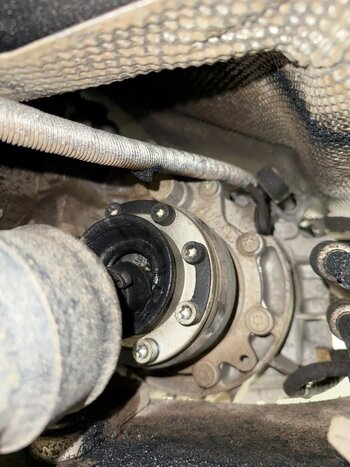
That is a very interesting theory and certainly not improbable. Think about what it’s like on a muddy track. You can get mud stuck up on the transfer case cross member.

IMG_0511.jpeg
 
Make a little bird cage that extends from the transfer case and protects the rubber from rock strikes?

I can totally see it
 
It seems to me like that would be difficult for a rock to lodge in there while it’s spinning, and it would clear.
 
I doubt it lodges itself there but if it hits at just about the right force i can see it making a tear.
I honestly cannot. This is fatigue from stress. Don’t waste your time with little cages. They need to utilize a different compound.
 
The design of the front axle is such that this is relatively hard compared to other trucks. It will require some other components to complete it as well.

It's doable, but a considerable task. Honestly it may be easier and cheaper to change the front axle out all together. Maybe a built Dana 44 or a 60 if you want over kill. But then you almost might as well swap the rear to a 60 as well.

If I can get a housing as a core I would be more than happy to start dissecting it to see what's truly possible. I have seen several detailed photos of the front axle torn down and understand the assembly, but I need it in hand.

An expensive proposition for sure. But then there's parting out the rest of the rig that may help offset the acquisition fee.

 
Back
Top Bottom