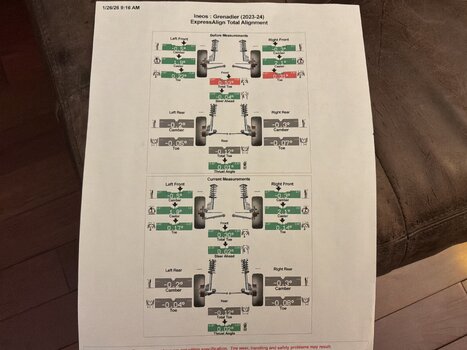
I do my own alignments and would agree with
@Dougn - address the caster first. For a lot of vehicles, caster isn't adjustable, but it is adjustable on the Grenny. I put a hash mark with a cold chisel on my eccentric washers at their widest point (you could alternately do the bolt head) so I can visually tell exactly where the bolt is positioned. Then I maxed out the caster. The vehicle tracks much nicer and takes about 90% fewer micro adjustments going straight down the highway.
For vehicles where it’s possible, some alignment shops will set extra caster on the driver's side to help compensate for the pulling caused by a crowned road - note that you have the opposite of that approach (more caster on the right) which would tend to exaggerate the effect of a crowned road. I don't set a caster split for myself
on vehicles where this is possible since every road is different and can result in a very slight pull on many roads.
Also ensure that each axle has equal tire pressure left to right. If after all this and it still pulls, swap the front tires left to right (no - don't dismount them) and do a short test drive to see if that changes anything. I have seen cases where odd tire wear or broken cords can cause pulling. You won't hurt the tires by running them backwards for a few miles if you avoid extreme acceleration and braking. If swapping the tires left to right improves the situation and the tires look okay otherwise, you could try dismounting them and swapping left to right (preserving the original direction of rotation). Or just replace them. I had several sets of non-LT Bridgestones Blizzaks on my Toyota 4Runner over the years that would get all squirrely for directional stability about halfway through their life and swapping them side to side usually improved the situation greatly. For clarity, these tires had even wear across the tread face and no internal damage.
When you test your vehicle for pulling, if you can't find a perfectly flat road (most aren't), find a slow, less travelled road and drive down the middle of the road so you're stradling the crown to negate pulling caused by the road camber. Or find a nice flat parking lot after the business is closed for the evening.
edits: an extraordinarily rude member who probably doesn’t have any friends and comes here to take out his frustrations on others pointed out that the
relative caster left to right is set by how the axle is assembled - quite true and a brain fart by me because I've been working on IFS vehicles since the '70's. Caster can, however, be decreased or increased to the max allowed by the lower links and fasteners. Exceed factory specs at your own peril. The issue here is an increased front driveshaft angle and it deleterious effect on the CV boot, but the difference in driveshaft angle between max factory caster and max possible caster is negligible.