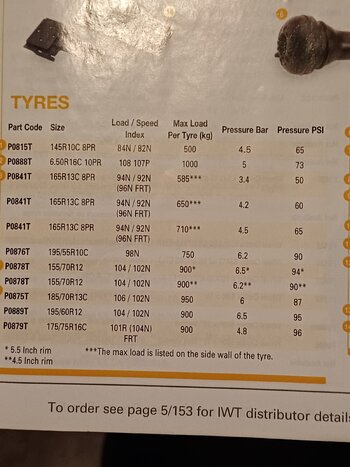

done. metric units are in.
i'll probably do a section tire size, width and contact patch shape as well. maybe tomorrow.
i'll probably do a section tire size, width and contact patch shape as well. maybe tomorrow.
Register a free account today to become a member! Once signed in, you'll be able to contribute to the community by adding your own topics, posts, and connect with other members through your own private inbox! INEOS Agents, Dealers or Commercial vendors please use the contact us link at the bottom of the page.

Very common size in the UK, most of the big trailer manufacturers use it, ( Ifor Williams et al). The tyres though are all common trailer brands but usually south Asian manufacturers.not the most common size to find, especially if you're up in load index 108 for that kind of load. I don't think you can even buy that tire in the US.
yeah i saw them in europe. i just did a cursory look but i could not find that size tire in that load factor in the us. I didn't look super hard though...Very common size in the UK, most of the big trailer manufacturers use it, ( Ifor Williams et al). The tyres though are all common trailer brands but usually south Asian manufacturers.
yeah i saw them in europe. i just did a cursory look but i could not find that size tire in that load factor in the us. I didn't look super hard though...

That Clark Kent guy wastes far too much time on here. He must be retired.


At that weight you're right at the limit, 3.3 bar or 48psi. Remember i added in a bit of safety buffer for leaky tires and poorly calibrated tire pressure meters.Am I reading this chart correctly? With a Grenadier at the 3400kg to 3500kg weight range with the OEM spec BFG 265/70 r17 tyres That I would be overweight for the ideal tyre pressure at highway speeds.
You can’t set an “ideal PSI” on a tyre that’s at max weight is my take ?
edit. To add to my confusion. These tyres have a maximum weight bearing capacity of 1450kg each so well within the max vehicle weight of 3500kg for a Grenadier.
No it’s OK I think there is enough safety margin. I was probably nearer 4 tonnes in Africa at times. Only issue was in deep sand at lower pressures where tyres were getting too hot. But that was travelling in mid afternoon heat, so extreme.At that weight you're right at the limit, 3.3 bar or 48psi. Remember i added in a bit of safety buffer for leaky tires and poorly calibrated tire pressure meters.
It's that buffer gets you over the limit. But strictly speaking you're right up near the limit with no buffer. I tend to want to have a bit of a safety margin so you're seeing that.
I could redo the table and eliminate the safety margin if it's misleading or creates concern.

Good catch! it comes in two load ranges at that size, E and C. I picked the wrong one. Lets me redo the table.The factory 17” BFG KO2 tires are load range E, with a max load of 3415 lbs @ 80psi. @parb , are you using the load range C numbers in your table?
Likewise on the factory installed 255/70 18” KO2s Load Range is D at least on my 24 MY unless they’ve changed the specifications for newer production models.Good catch! it comes in two load ranges at that size, E and C. I picked the wrong one. Lets me redo the table.
Edit, table redone for the correct load rating. i added an explicit table highligting the load ratings used for each tire. Because the higher load rating comes with a stiffer sidewall the entire table had to be recomputed.

My own 2023 tyresLikewise on the factory installed 255/70 18” KO2s Load Range is D at least on my 24 MY unless they’ve changed the specifications for newer production models.
View attachment 7917686
Hi @parb step 2 still needs to be edited as it still references KO2 tyres with a 117 load rating.Good catch! it comes in two load ranges at that size, E and C. I picked the wrong one. Lets me redo the table.
Edit, table redone for the correct load rating. i added an explicit table highligting the load ratings used for each tire. Because the higher load rating comes with a stiffer sidewall the entire table had to be recomputed.