The Grenadier Forum

Register a free account today to become a member! Once signed in, you'll be able to contribute to the community by adding your own topics, posts, and connect with other members through your own private inbox! INEOS Agents, Dealers or Commercial vendors please use the contact us link at the bottom of the page.

Rear Seat delete options

washingthegreaseoff

Grenadier Owner
Local time
2:08 AM
Joined
Nov 1, 2025
Messages
54
Location
New Mexico
Thinking about replacing the rear seats with a flat floor over the battery electronics. I know GP Factor and Goose Gear have kits available, but, I don't really need to replace the entire rear floor, just want a panel like you get in Europe with the 2 seat model. Does anyone else make something like this, or am I making my own?
 
Thinking about replacing the rear seats with a flat floor over the battery electronics. I know GP Factor and Goose Gear have kits available, but, I don't really need to replace the entire rear floor, just want a panel like you get in Europe with the 2 seat model. Does anyone else make something like this, or am I making my own?
Factory 2 seaters have a big metal battery box in the rear. That would not be an option I suspect. So you may need to make your own.
 
Last edited:
I have removed both seat bases in the rear. Has anyone deleted just the 60 side back rest and retained the 40 side? I would like to make the 60/40 rear seat an optional quick reconfigure if I needed only a single rear passenger.
It looks like cutting the steel frame is necessary, however without removing the complete assembly, I can't see if the seat back can be disassembled individually from the frame.
 
I haven't seen any photos of the 2 seat setup, but, I guess it makes sense. Huh. Oh well, looks like I'm building my own.
This is it, ignore water tank on left of image.

IMG_9298.jpg


Driver's side looking towards the cargo barrier. (RHD).
IMG_9299.jpg
 
Last edited:
I added a gas strut to one side, so the metal lid is now very easy to open and shut.

As you can see the cargo barrier is attached to the big battery box at the bottom.

The water tank has a tray under it, so if it leaks the leaking water does not go into the battery box electrics, but to the floor of the car - via the green hose you see (one on each side of the tray).
 
I added a gas strut to one side, so the metal lid is now very easy to open and shut.

As you can see the cargo barrier is attached to the big battery box at the bottom.

The water tank has a tray under it, so if it leaks the leaking water does not go into the battery box electrics, but to the floor of the car - via the green hose you see (one on each side of the tray).
What strength of strut did you go with? I found that one was not enough and added another on the LHS.
 
What strength of strut did you go with? I found that one was not enough and added another on the LHS.
It is all about the pressure in the gas strut. I will try and find mine for you.

EDIT: Details here (50kg), the installer customised the pressure so it worked perfectly:

 
Last edited:
It is all about the pressure in the gas strut. I will try and find mine for you.

EDIT: Details here (50kg), the installer customised the pressure so it worked perfectly:

Not sure about the kg rating but I know have 2 x 150nm struts that work well - you have to be prepared to cut a metal support backet on the passenger side though. I'll check the kg rating vs nm.
 
Not sure about the kg rating but I know have 2 x 150nm struts that work well - you have to be prepared to cut a metal support bracket on the passenger side though. I'll check the kg rating vs nm.
Installer gave me the figure as 50kg.
 
Installer gave me the figure as 50kg.
50Kg = 490 Newtons. So, I have 2 x 150N. I'd be interested in seeing the label on the strut - usually they are rated in Newtons. Next time you're in that area, see what the strut label says.
 
50Kg = 490 Newtons. So, I have 2 x 150N. I'd be interested in seeing the label on the strut - usually they are rated in Newtons. Next time you're in that area, see what the strut label says.
It probably says little. The installer selected the right size strut, installed the strut and then he gassed it so the strut could handle the weight of the lid. He took two attempts to get it right. The first was close, but he wanted it perfect!

His setup in his Dual Cab ute allowed him to alter strut pressure exactly the way he needed it.

He told me 50kg as I made a note. I am just parroting what he gave me.
 
Thinking about replacing the rear seats with a flat floor over the battery electronics. I know GP Factor and Goose Gear have kits available, but, I don't really need to replace the entire rear floor, just want a panel like you get in Europe with the 2 seat model. Does anyone else make something like this, or am I making my own?
My Rear Seat Delete
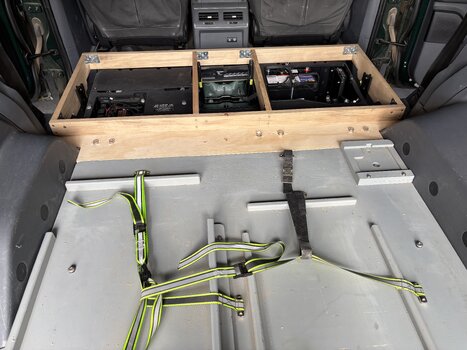
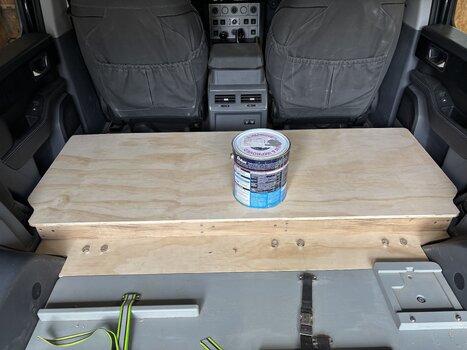
This is the way that I went about building a seat delete platform. I want to be able to remove and replace the seat easily, so the simpler the better. I was not worried about getting a platform that was the same height as the rear. I was just interested in removing the weight of the seat and having space where I can securely stow camping gear.

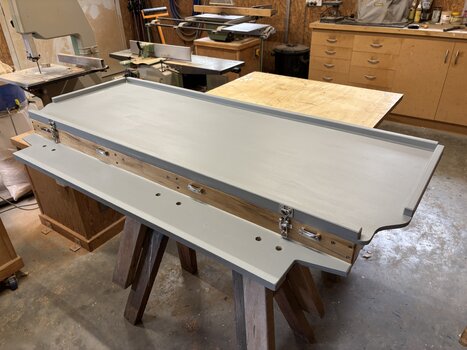
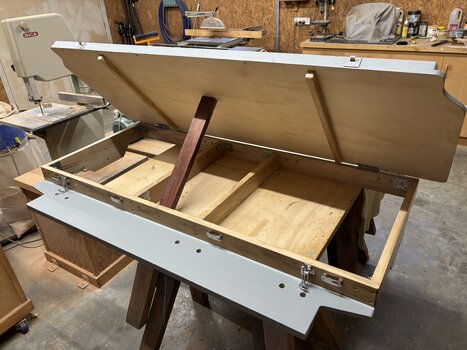
I therefore chose to leave the seat brackets and the plastic trim around the electrics in place. I used the seat brackets to support the base, which required raising it 70mm above the rear platform. This was done with 70 x 20mm hardwood framing, with deeper sections to use both bolts on each of the two outer brackets. Starting the raised base in front of the wheel arches enabled the frame to be rectangular for the simplest and strongest solution. The platform is hinged at the front, with over-centre catches at the rear, so complete access to the electrics, with no hatches required. Front and rear platforms are both 12mm exterior grade plywood.

The total cost of the seat delete was just under $A100; I had the solid timber already. I think this is slightly cheaper than commercially available options and weighs 13kg, so a big weight saving.

 

Attachments

  • Frame in place.JPG
    Frame in place.JPG
    7.8 MB · Views: 0
  • Platform in place.JPG
    Platform in place.JPG
    7.4 MB · Views: 0
  • Finished seat delete.JPG
    Finished seat delete.JPG
    7.1 MB · Views: 0
  • Platform opened.JPG
    Platform opened.JPG
    7.6 MB · Views: 0
My Rear Seat Delete
This is the way that I went about building a seat delete platform. I want to be able to remove and replace the seat easily, so the simpler the better. I was not worried about getting a platform that was the same height as the rear. I was just interested in removing the weight of the seat and having space where I can securely stow camping gear.

I therefore chose to leave the seat brackets and the plastic trim around the electrics in place. I used the seat brackets to support the base, which required raising it 70mm above the rear platform. This was done with 70 x 20mm hardwood framing, with deeper sections to use both bolts on each of the two outer brackets. Starting the raised base in front of the wheel arches enabled the frame to be rectangular for the simplest and strongest solution. The platform is hinged at the front, with over-centre catches at the rear, so complete access to the electrics, with no hatches required. Front and rear platforms are both 12mm exterior grade plywood.

The total cost of the seat delete was just under $A100; I had the solid timber already. I think this is slightly cheaper than commercially available options and weighs 13kg, so a big weight saving.


What’s that @TonyF ??? And you’d be happy to make another one for me for $300 odd??
Let me know when I can pick it up.!! 😉
 
Last edited:
Back
Top Bottom