The Grenadier Forum

Register a free account today to become a member! Once signed in, you'll be able to contribute to the community by adding your own topics, posts, and connect with other members through your own private inbox! INEOS Agents, Dealers or Commercial vendors please use the contact us link at the bottom of the page.

Please send me your old ZF transmission pan and filter

As I recall (manual not presently to hand) the first step in the Ineos-defined process is to put the lever in the mid (neutral) position before operating the screw on the transfer box (hence my deduction that the function of the screw is only to lock the selector).

If someone could devise a method to lock the lever within the cab once neutral was selected I see no reason why this would be less robust than Ineos's recommended method.
 
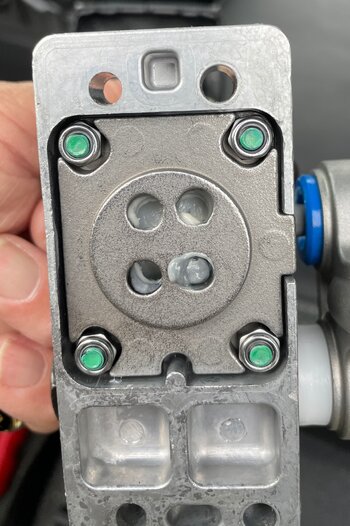
There are four holes in the plate on the underside of the shifter into which the spring loaded rod connected to the manually operated collar in the shifter. These four holes provide a positive detent for the high / low / diff lock shifter positions. I wonder if the vagaries in the cable setup would make milling a precise detent in between the H and L holes in the shifter a non starter - not to mention the lack of space between the & L holes.

Photos posted again to show underside of a shifter assembly removed from a vehicle.
 

Attachments

  • IMG_7715.jpeg
    IMG_7715.jpeg
    4.4 MB · Views: 13
  • IMG_7725.jpeg
    IMG_7725.jpeg
    2.7 MB · Views: 10
Yall are overthinking it. The nature of the cable setup provides a decent amount of friction. It would take direct force on the knob of the lever to kick it out of neutral. So unless you plan to get recovered by a monster truck with a chain you should be just fine.
 
The Ineos diesel has the ZF 8HP76. The above kit will not work. The lever on the h8HP76 is different.View attachment 7917350
Looks as if you could pull down and position some kind of wedge between the lever & the nose of the transmission housing. I wouldn't be surprised if some "special tool" existed to perform this.
 
Looks as if you could pull down and position some kind of wedge between the lever & the nose of the transmission housing. I wouldn't be surprised if some "special tool" existed to perform this.
But that negates the purpose of this current conversation. You have to assume no access to the underside of the truck when you need this function. So either you cobble a cable setup to actuate the park pawl lever on the trans or you use the Hi/Lo shifter that the Ineos Gods gave you already in the cab.
 
But that negates the purpose of this current conversation. You have to assume no access to the underside of the truck when you need this function. So either you cobble a cable setup to actuate the park pawl lever on the trans or you use the Hi/Lo shifter that the Ineos Gods gave you already in the cab.
Absolutely!

I think we all here have understood by now that your favourite is the xfer case N ;). And it's also mine! Didn't I mention before that I have used it several times already?

However, we should be allowed to discuss alternate methods. I'd rather have one more option than one too few. Not to mention that I believe we should acquire comprehensive knowledge about how stuff we buy works...
 
Absolutely!

I think we all here have understood by now that your favourite is the xfer case N ;). And it's also mine! Didn't I mention before that I have used it several times already?

However, we should be allowed to discuss alternate methods. I'd rather have one more option than one too few. Not to mention that I believe we should acquire comprehensive knowledge about how stuff we buy works...
Fair enough, you just didn't indicate you were deviating even further off the actual subject. Yes it's valuable as an alternate solution for some situation.

This forum is full of people jumping in the middle and rehashing every detail as if it's never seen the light of day. That is what your post felt like but clearly is not with your additional explanation.
 
Fair enough, you just didn't indicate you were deviating even further off the actual subject. Yes it's valuable as an alternate solution for some situation.

This forum is full of people jumping in the middle and rehashing every detail as if it's never seen the light of day. That is what your post felt like but clearly is not with your additional explanation.
Appreciated!
BTW: The original subject was "Please send me your old ZF transmission pan and filter", nothing relatied to transfer case neutral. But: Even we admittedly diverted from that topic, I find this thread comparatively useful. Just my opinion.
 
Appreciated!
BTW: The original subject was "Please send me your old ZF transmission pan and filter", nothing relatied to transfer case neutral. But: Even we admittedly diverted from that topic, I find this thread comparatively useful. Just my opinion.
100%, I kinda feel bad that we high jacked this one so much. We kept getting farther into the weeds!
 
I cannot find the middle position. Not sure why. It's a stiff shift from high to low. Maybe just more use?
The first time or two you try it will be a bit tricky. As the case comes out of high it tends to pop into low pretty easily. The cable system is a bit vague and kind of annoying. Not nearly as positive as the old LR version with the LT230.
 
As I recall (manual not presently to hand) the first step in the Ineos-defined process is to put the lever in the mid (neutral) position before operating the screw on the transfer box (hence my deduction that the function of the screw is only to lock the selector).

If someone could devise a method to lock the lever within the cab once neutral was selected I see no reason why this would be less robust than Ineos's recommended method.

This (bold) has bugged me for a while. The MY23 owner's manual did not include this first step. That was added from MY24 onwards. Perhaps this was in response to a few early reports where guys wound in the neutral screw until it stopped but still could not get the transfer case into neutral.
Today I took a look at how this neutral stop screw works. The only info available is via the parts catalogue so it took me a while to manipulate a view that shows how the high and low gears are arranged either side of the input shaft, how the sliding selector works, and of course how the neutral stop screw works.

High and Low Range. Anyone that has spent time inside a gearbox will recognise these mechanisms. The cabin HI-LO range selector lever is connected to the gear selector lever via a bowden cable. Movement of the gear selector lever moves the selector fork along the selector rail. The selector fork slides the selector ring along the straight gear cut in the input shaft. As represented here, movement of the selector ring to the left will engage the low gear (low range) and movement to the right will engage the high gear (high range). Power is then transmitted through other gears to the centre differential and the forward and rear driveshaft flanges (all deleted for clarity).

The Neutral Stop Screw. As @Blackwolf correctly deduces the neutral stop screw engages in the selector fork to lock it in place. When the screw is wound in the tip of the screw rough aligns to the inverted V notch in the fork. That makes placing the first step of placing the shifter to mid-travel important so the screw will lead into the notch. Once the screw is bottomed out the selector fork and selector ring are mechanically locked between the high and low gears so drive from the input shaft is interrupted, i.e. a neutral position. The stop screw provides a positive lockout so the transfer case will remain in neutral during transportation or recovery.

Enjoy.
Transfer Case Selectors and Neutral Stop Screw.jpg
 
This (bold) has bugged me for a while. The MY23 owner's manual did not include this first step. That was added from MY24 onwards. Perhaps this was in response to a few early reports where guys wound in the neutral screw until it stopped but still could not get the transfer case into neutral.
Today I took a look at how this neutral stop screw works. The only info available is via the parts catalogue so it took me a while to manipulate a view that shows how the high and low gears are arranged either side of the input shaft, how the sliding selector works, and of course how the neutral stop screw works.

High and Low Range. Anyone that has spent time inside a gearbox will recognise these mechanisms. The cabin HI-LO range selector lever is connected to the gear selector lever via a bowden cable. Movement of the gear selector lever moves the selector fork along the selector rail. The selector fork slides the selector ring along the straight gear cut in the input shaft. As represented here, movement of the selector ring to the left will engage the low gear (low range) and movement to the right will engage the high gear (high range). Power is then transmitted through other gears to the centre differential and the forward and rear driveshaft flanges (all deleted for clarity).

The Neutral Stop Screw. As @Blackwolf correctly deduces the neutral stop screw engages in the selector fork to lock it in place. When the screw is wound in the tip of the screw rough aligns to the inverted V notch in the fork. That makes placing the first step of placing the shifter to mid-travel important so the screw will lead into the notch. Once the screw is bottomed out the selector fork and selector ring are mechanically locked between the high and low gears so drive from the input shaft is interrupted, i.e. a neutral position. The stop screw provides a positive lockout so the transfer case will remain in neutral during transportation or recovery.

Enjoy.
View attachment 7917566

Excellent detective work and an exceptionally useful and informative post.

I think it likely that the original intent was that the width of the 'V' on the selector fork was sufficient for the locking screw to move the selector into the neutral position from either H or L, and indeed it quite possibly is so. The obvious flaw in this strategy is that the change lever in the cab will be locked in either H or L by its detent pin and damage will inevitably result. This may explain the changed instructions in later manuals.

Either way it is clearly apparent that selecting N with the lever in the cab will be wholly satisfactory for something like a towed recovery from water.
 
So getting the TC into neutral with the screw alone might not work in some situations?
Thus the importance of finding N on the Hi Lo selector?
It's hard to know if the screw alone would produce enough force to drag the selector fork into the locked position. It's a wedge arrangement so it should but the drag of the cable and the shifter is fighting the screw if they are not coarsely aligned. The load while turning the screw could convince you it has bottomed out when it's actually just working against the notch (there is a wear pad on the tip of the screw, not shown).
They added that extra step so it seems important enough to do it.

Mine sounds like yours. It wants to tip one way or the other. If you have the ignition key on the TRANSFER CASE IN NEUTRAL telltale light is a good guide to practice finding the sweet spot.
 
Mine sounds like yours. It wants to tip one way or the other. If you have the ignition key on the TRANSFER CASE IN NEUTRAL telltale light is a good guide to practice finding the sweet spot.
I'll keep trying. So far the light hasn't lit!
I'll also play with the TC screw to make sure the telltale works.
 
I'll keep trying. So far the light hasn't lit!
I'll also play with the TC screw to make sure the telltale works.
The same tricks apply for getting into a sticky low range. Release the park brake. Allow the vehicle to roll a bit on the brakes. Transmission in neutral (or use car wash mode).
Any pressure between the input shaft and the selector ring will fight your efforts to caress the shifter into the DMZ.
Light a candle. Put some music on. Speak French.
 
I can normally get mine into low fairly easily but it’s back into high from low that I sometimes struggle. It’s ok on a slight slope but on level ground still not that easy.
 
OK I have loosened the shifter by manipulating it about 50 times.
Yet despite two hands on the shifter and moving it from L to H in 1mm increments it will not nail Goldilocks. It just suddenly slips into H.
Not something you want in an emergency and hence the option to remotely unlock the ZF remains on the table.
This might just be an issue for MY23 Grenadiers, I don't know, wouldn't know why. Has anyone with a MY23 been able to find the sweet spot, and if so 1 or 2 hands on the knob?
Don't be dirty!
 
Back
Top Bottom