@Jeffrey here are the actual sales numbers for Ineos in the USA. Good news is 2026 is trending positively. For perspective in March of 2026 Ford F-Series sold 62,238 units.
------
Q1 2026 Sales Flash
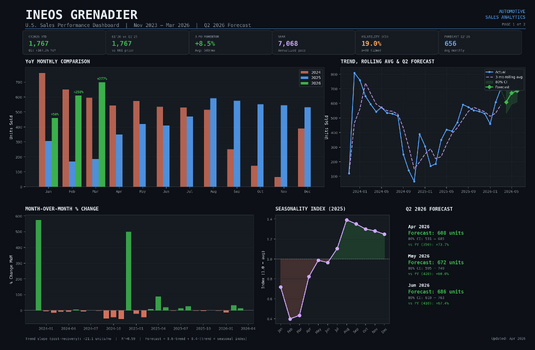
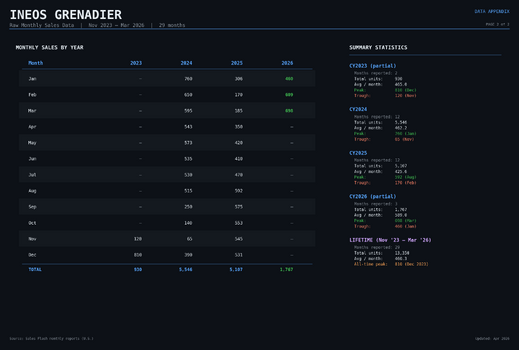
Ineos closed Q1 2026 at 1,767 Grenadiers, with three consecutive months of strong year-over-year growth (Jan, Feb +49%, Mar +43%). March's 698 units is the brand's highest monthly volume since the Dec 2023 launch peak. The recovery that began mid-2025 has now compounded into clear momentum, and Q1 alone has already exceeded the entire first half of 2024.
The trend-seasonal model points to a Q2 run-rate around 655 units/month (Apr 608 / May 672 / Jun 686), with seasonal tailwinds setting up a stronger Q3 if the 2025 Aug-Sep peak pattern repeats. Holding this trajectory, full-year 2026 plausibly lands in the 7,000–7,500 range, roughly +40% over 2025. The current annualized SAAR is 7,068. Risks worth watching are production and dealer-network capacity, the historical summer softness pattern compressing Q3, and any cooling in the premium 4x4 segment. The forecast carries R²=0.59, directionally sound but with real month-to-month noise (12-month CV is 19%).
Special commentary: the fleet question
Fleet channels are the most accessible lever Ineos has for scaling volume, and the corporate case is straightforward. Government, utility, and commercial contracts can move 50–500+ units in a single deal, smoothing factory utilization and hardening dealer service economics. A high-profile fleet win, military, parks, search-and-rescue also delivers the kind of credibility that retail marketing can't buy. Land Rover Defender and Mercedes G-Wagon both built premium brand equity on top of decades of working-vehicle pedigree, so fleet penetration done with the right partners can reinforce rather than dilute the Grenadier's "authentic 4x4" positioning.
Private owners have legitimate concerns on the other side of the ledger.
Fleet volume compresses retail transaction prices in the near term, and 3–5 years out, fleet turnover floods the used market with utility-spec examples that drag comparable values down. The Grenadier's value proposition leans heavily on
premium positioning and exclusivity, both thin as fleet share rises.
The deciding variable is execution. Fleet sales done well, separate trim and spec ladder, distinct VIN sequencing, capped at a disciplined percentage of total mix (industry convention is keeping retail above ~70% to protect residuals), and transparent disclosure and grow the business without compromising it. Done poorly, heavy discounting, undifferentiated configurations, opaque mix reporting and the resale concerns are well-founded. The leading indicators for owners and dealers to watch are whether Ineos announces fleet programs with distinct specs and whether they publish the mix percentage. Discipline on those two points is the difference between fleet as accretive volume and fleet as a brand tax.
A broad Hertz North America deployment would be a residual-value disaster; high-mileage abuse cycles, mass auction dumping at 18–24 months, and the Grenadier sitting next to economy sedans on rental lots quickly hollows out premium positioning. But a geographically targeted adventure-rental program...Moab, Maui and the Big Island, Jackson Hole, Sedona, maybe Iceland or Costa Rica through specialty operators works on entirely different mechanics. Volumes are naturally capped (destination markets can only absorb so many units), the use case is on-brand (sand, slickrock, water crossings, what the truck was built for), and these vehicles tend to stay regional through their second life rather than flooding national auction lanes. The Jeep Wrangler in Hawaii is the playbook: decades of rental presence that strengthened rather than damaged the model's residuals, because the rental experience itself functioned as a multi-day test drive for aspirational buyers.
The marketing math is better than the unit math suggests. A tourist who spends a week on Hells Revenge in a Grenadier rental is far more likely to buy one than a passive showroom visitor, and the byproduct is the kind of UGC and brand association paid media can't buy. Done well, destination rental functions as a marketing program with a small fleet-sales tail, not the other way around. The discipline is keeping it that way, partner with specialty rental operators rather than corporate airport counters, cap North American rental allocation at roughly 1–2% of total volume, and limit it to markets thin enough that eventual used inventory gets absorbed locally without dragging national pricing.
------

 media.ineosgrenadier.com