The Grenadier Forum

Register a free account today to become a member! Once signed in, you'll be able to contribute to the community by adding your own topics, posts, and connect with other members through your own private inbox! INEOS Agents, Dealers or Commercial vendors please use the contact us link at the bottom of the page.

Front Drive Shaft Update

Ok So I'm replacing the CV joint on my front drive shaft. I have been carefully inspecting the boot which had only just torn and I caught it before any grease had come out. It tore radially exactly along the line of the gradient change in the thickness of the boot palpable when you insert your finger into the boot.
So please excuse me but from observation of my boot it does not look like a pinch and in fact if you take the still good axel end CV joint to its extreme range and shine a light behind you can clearly see a gap at the apex of the fold. There is no possibility of a pinch that I can see. See images. Or am I missing something. ???

img_4596-jpg.7924183
View attachment 7924184
Possibly road debris; we have raised this scenario before.
 
Ok So I'm replacing the CV joint on my front drive shaft. I have been carefully inspecting the boot which had only just torn and I caught it before any grease had come out. It tore radially exactly along the line of the gradient change in the thickness of the boot palpable when you insert your finger into the boot.
So please excuse me but from observation of my boot it does not look like a pinch and in fact if you take the still good axel end CV joint to its extreme range and shine a light behind you can clearly see a gap at the apex of the fold. There is no possibility of a pinch that I can see. See images. Or am I missing something. ???

img_4596-jpg.7924183
View attachment 7924184
Looks a lot like the boot fail on mine.
 

Attachments

  • IMG_4906.jpeg
    IMG_4906.jpeg
    3.7 MB · Views: 0
Ok So I'm replacing the CV joint on my front drive shaft. I have been carefully inspecting the boot which had only just torn and I caught it before any grease had come out. It tore radially exactly along the line of the gradient change in the thickness of the boot palpable when you insert your finger into the boot.
So please excuse me but from observation of my boot it does not look like a pinch and in fact if you take the still good axel end CV joint to its extreme range and shine a light behind you can clearly see a gap at the apex of the fold. There is no possibility of a pinch that I can see. See images. Or am I missing something. ???

img_4596-jpg.7924183
View attachment 7924184
The only thing that stops the joint is "pinching". Meaning the max angle you found was due to the joint hitting physical limits due to the boot and the boot flange. If you remove the boot completely you can disassemble the joint by over rotating it. The pinch happens behind where your light is coming through. Your boot failed in a very normal manner and ist how they all fail. Cut a cross section of your boot and you will likely find the thickness of the boot varies at the spot it was split. The boot however should be uniform thickness in the area it split.
 
This will be a hugh problem for Grenadier owners when the 5 yr warranty runs out. Most of us are not equipped or knowledgeable to do this type of repair. Most of us non-overlanders , do typically drive ~80 mph on pavement much much more than 20-30 mph on trails.

Values of used Grennys will plummet when the warranty ends, unless IA steps up and extends the warranty for certain parts. All this certainly puts a fear in us non-overlanders (ok, posers).
 
This will be a hugh problem for Grenadier owners when the 5 yr warranty runs out. Most of us are not equipped or knowledgeable to do this type of repair. Most of us non-overlanders , do typically drive ~80 mph on pavement much much more than 20-30 mph on trails.

Values of used Grennys will plummet when the warranty ends, unless IA steps up and extends the warranty for certain parts. All this certainly puts a fear in us non-overlanders (ok, posers).
Takes all kinds of users to make a company succeed.
 
This will be a hugh problem for Grenadier owners when the 5 yr warranty runs out. Most of us are not equipped or knowledgeable to do this type of repair. Most of us non-overlanders , do typically drive ~80 mph on pavement much much more than 20-30 mph on trails.

Values of used Grennys will plummet when the warranty ends, unless IA steps up and extends the warranty for certain parts. All this certainly puts a fear in us non-overlanders (ok, posers).
If the new aftermarket driveshafts function well and increase the longevity of the driveshaft, I don’t think this will have a large effect on the value long term. It’s a very niche car with a particular buyer. It takes a few years for them to all sort out and for the right cars to end up with the right buyers. Many values of niche cars behave this way and it isn’t uncommon for the aftermarket to solve a design flaw. One day the first question before buying may be “Does it have the Sven or Dakota driveshaft installed yet?”
 
Last edited:
If the new aftermarket driveshafts function well and increase the longevity of the driveshaft, I don’t think this will have a large effect on the value long term. It’s a very niche car with a particular buyer. It takes a few years for them to all sort out and for the right cars to end up with the right buyers. Many values of niche cars behave this way and it isn’t uncommon for the aftermarket to solve a design flaw. One day the first question before buying may be “Does it have the Sven or Dakota driveshaft installed yet?”

Agreed, I think its going to be similar to asking about the IMS bearing on certain Porsches, rod bearings on the E90/92, and the crankhub on the following gen of M cars.
 
@Matt P why was your post removed from here and from the Facebook group? Please tell me that Ineos didn’t ask you to remove it. You are a high profile own with substantial influence. It’s one thing if you decided you didn’t want to share but it’s very different if you were asked to remove it.
My initial post was supposed to be a friendly heads up to the community on ONE of the ways to identify a potential driveshaft failure visually, BEFORE it happens, (as quite a few people have asked what they should be looking for) but it caused a bit of confusion as it wasn’t the commonly seen cv boot tear. I hope this clear things up a bit.

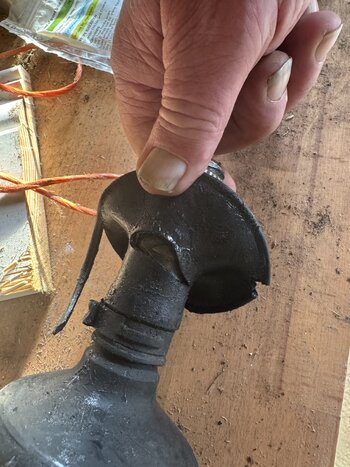
The grease seen was from the driveshaft not, the transfer output shaft. It came from the back cover of the universal joint (see pic) due to a hole, soon to be two holes, made from the inside. If this had gone unnoticed, the driveshaft would ultimately fail.

I hope this helps explain things a little more. There are of course other signs to be aware of. In our case, it’s down to suspension flexing and too much articulation on the joint. We had an opportunity to change it out and so we did. Could it have gone longer? Possibly, but for us, it wasn’t worth the risk with the journey we’re on. 66,000km. No lift. Towing 95% of the time, large majority of our journey is off road. 👍

I deleted the original post to keep things as simple, accurate and helpful as possible. 🙏 (This one has more info with pics. Some people don't read all the comments and so I thought this was the best way to do it.)
21.JPG


21aa.png

21ab.png

21ad.png

You_Doodle_2026-03-18T19_09_46Z.jpg

You_Doodle_2026-03-18T19_12_39Z.jpg
 
My initial post was supposed to be a friendly heads up to the community on ONE of the ways to identify a potential driveshaft failure visually, BEFORE it happens, (as quite a few people have asked what they should be looking for) but it caused a bit of confusion as it wasn’t the commonly seen cv boot tear. I hope this clear things up a bit.

The grease seen was from the driveshaft not, the transfer output shaft. It came from the back cover of the universal joint (see pic) due to a hole, soon to be two holes, made from the inside. If this had gone unnoticed, the driveshaft would ultimately fail.

I hope this helps explain things a little more. There are of course other signs to be aware of. In our case, it’s down to suspension flexing and too much articulation on the joint. We had an opportunity to change it out and so we did. Could it have gone longer? Possibly, but for us, it wasn’t worth the risk with the journey we’re on. 66,000km. No lift. Towing 95% of the time, large majority of our journey is off road. 👍

I deleted the original post to keep things as simple, accurate and helpful as possible. 🙏 (This one has more info with pics. Some people don't read all the comments and so I thought this was the best way to do it.)
View attachment 7924220

View attachment 7924222
View attachment 7924224
View attachment 7924226
View attachment 7924227
View attachment 7924229

So that's a Circlip failure from lots of articulation and pushing and pulling on the retaining clip. Interesting that they still happen at the Transfer box end not the axel end.
 
The only thing that stops the joint is "pinching". Meaning the max angle you found was due to the joint hitting physical limits due to the boot and the boot flange. If you remove the boot completely you can disassemble the joint by over rotating it. The pinch happens behind where your light is coming through. Your boot failed in a very normal manner and ist how they all fail. Cut a cross section of your boot and you will likely find the thickness of the boot varies at the spot it was split. The boot however should be uniform thickness in the area it split.
Yes there is a definite step in thickness that actually symmetrical through the whole radius of the boot - ie all the way round at that exact point where it fails. Is this how the boot was made with a step in thickness? Or is this the wear with motion? The tear is exactly along the change in thickness of the rubber.
 
Yes there is a definite step in thickness that actually symmetrical through the whole radius of the boot - ie all the way round at that exact point where it fails. Is this how the boot was made with a step in thickness? Or is this the wear with motion? The tear is exactly along the change in thickness of the rubber.
That's the area being pinched. The boot in that area is supposed to be uniform thickness. But the pinching causes a step down then a taper back to full thickness.
 
So that's a Circlip failure from lots of articulation and pushing and pulling on the retaining clip. Interesting that they still happen at the Transfer box end not the axel end.
Clip failure happens at the T-case because the joint is under more stress from exceeding its max operational angle. The diff side does not exceed the joints max angle.
 
My initial post was supposed to be a friendly heads up to the community on ONE of the ways to identify a potential driveshaft failure visually, BEFORE it happens, (as quite a few people have asked what they should be looking for) but it caused a bit of confusion as it wasn’t the commonly seen cv boot tear. I hope this clear things up a bit.

I assume sections of the inner race in between the ball bearings cavities is coming in contact with the back cover plate during over articulation causing those dents and holes? Was the retaining clip broken also and the broken bits pierced the cover plate? It’s amazing to see how hot grease can find its way between the back of the cv joint and transfer case flange then out through what I assume are weep holes in the flange.
 
Last edited:
Back
Top Bottom