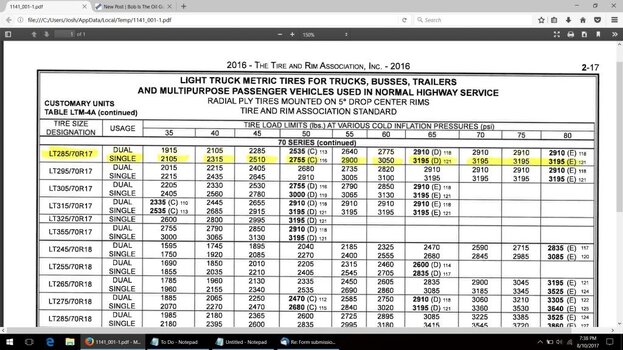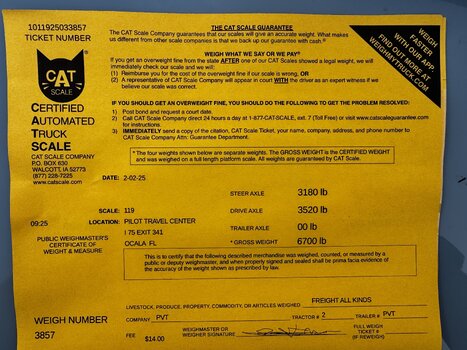

I can do all three. Probably tomorrow.
Register a free account today to become a member! Once signed in, you'll be able to contribute to the community by adding your own topics, posts, and connect with other members through your own private inbox! INEOS Agents, Dealers or Commercial vendors please use the contact us link at the bottom of the page.


Yeah, I’ve found the KO3s can accumulate a bit of heat (Atacama Desert, ambient temp mid-30s celsius). Nothing problematic, but noticeably hotter than the KO2s (Simpson/Central Desert, mid-high 40s celsius) for otherwise similar pressure/use on fast gravel with patches of tarmac.Related to the temp and pressure thing, but something that I ran across last year. Highway driving with 285/70R19s KO3s, a 70-80 degree day, but at 7-10,000 ft altitude, highway driving, probably 75-85mph.. The tires were new and they had been filled to the door plat pressure- 35+ish? I ended up getting pretty high temps, maybe even a high tire temp warning. I'm guessing that the temp would be an issue mainly in highway driving, on hotter days.
What is 'too hot' for a tire like ours? Is there a specific tire inflation target for that? I was loaded, but not over loaded. Two people plus gear.

The Falken Wildpeaks AT4s are definitely running cooler than the KO2s. I just had to put in some more air, the KO2's would quickly go from 35PSI cold to 40PSI. The AT4s only move to around 38PSI after sustained use. Tyre temps are also lower.Yeah, I’ve found the KO3s can accumulate a bit of heat (Atacama Desert, ambient temp mid-30s celsius). Nothing problematic, but noticeably hotter than the KO2s (Simpson/Central Desert, mid-high 40s celsius) for otherwise similar pressure/use on fast gravel with patches of tarmac.


Yes. The window in which it alerts you, for both high and low, is pretty sensitive compared to other brands. It's annoying, but it just alternates with it yelling at me about overdue for service.So what is the max temp for a tire like KO3 or Baja?
Why do I seem to get more tire pressure warnings with my IG than with any other car I’ve had? Is it the 17 inch rims and the general tire size? Something to do with the range of pressures that will trigger warnings?


And Celsius pleaseThere is a great point made that i glossed over.
The tables are generally oriented around 70F/20C ambient weather. It's the climate i typically have where i live.
What if you live in a different climate or have bigger swings?
I'll add this to the sheet, but yes you should temperature adjust. This is cold tire pressure should be adjusted depending on the ambient temperature,
I'll get this into the doc, i just calculated it out on my tablet while watching fireworks on the TV.
Basically at these temps
Under 20F add +4 psi over what the cheat sheet says
20 - 40F add +2 psi
40-85F follow the table
85-100F reduce -2 psi
Over 100F reduce -4 psi
I'll get it in tomorrow in pai, bar and kpa.


EDIT. Dropped the max to 40 deg C that’s more than enough.There is a great point made that i glossed over.
The tables are generally oriented around 70F/20C ambient weather. It's the climate i typically have where i live.
What if you live in a different climate or have bigger swings?
I'll add this to the sheet, but yes you should temperature adjust. This is cold tire pressure should be adjusted depending on the ambient temperature,
I'll get this into the doc, i just calculated it out on my tablet while watching fireworks on the TV.
Basically at these temps
Under 20F add +4 psi over what the cheat sheet says
20 - 40F add +2 psi
40-85F follow the table
85-100F reduce -2 psi
Over 100F reduce -4 psi
I'll get it in tomorrow in pai, bar and kpa.

My other suggestion here in warm environments is to let your tyres warm up a bit (eg increase in pressure 2-4 psi) before hitting the cold tyre pressure reset, so that you stay within the +/- 4 psi operating range of the TPMS throughout the day.There is a great point made that i glossed over.
The tables are generally oriented around 70F/20C ambient weather. It's the climate i typically have where i live.
What if you live in a different climate or have bigger swings?
I'll add this to the sheet, but yes you should temperature adjust. This is cold tire pressure should be adjusted depending on the ambient temperature,
I'll get this into the doc, i just calculated it out on my tablet while watching fireworks on the TV.
Basically at these temps
Under 20F add +4 psi over what the cheat sheet says
20 - 40F add +2 psi
40-85F follow the table
85-100F reduce -2 psi
Over 100F reduce -4 psi
I'll get it in tomorrow in pai, bar and kpa.
In my experience temperature is more critical ultimately than pressure as with high temps you can get tyre carcass (usually side wall) delamination without seeing a pressure spike.So what is the max temp for a tire like KO3 or Baja?
Why do I seem to get more tire pressure warnings with my IG than with any other car I’ve had? Is it the 17 inch rims and the general tire size? Something to do with the range of pressures that will trigger warnings?
Thank you Pari updated the document. Formatted it for easier reading
For the cheat sheets i put in entries for extreme heat and extreme cold.
3 versions of the cheat sheet, Bar / KG, PSI / LBS and kPA / Kg.
Thank you all for your helpful feedback. Sometimes you get blind when you stare at a document for too long, and what seems obvious to me is convoluted to others
I complete feel the same, i have truly enjoyed the Rok_Dr manual -its how i have traced all my relays and fuses for my high load circuits and modified them to suit how i wanted them to operate. A task that would have been significantly more effort without your incredible body of work. Thank you!Thank you Par
I know exactly what you mean and I have the same challenges with writing the Rok_Dr manual. This and your other white papers are valuable contributions and I’ll be referencing you with links to the documents in the next edition of the manual.
Thank you again.
Cheers
Steve