It's time to stop fighting the manual. Or if you don't want to do that at least stop fighting those who do want to follow it.
I don't much care for an argument based on normalising a practice that is contrary to the OEM's instructions. To stick with "that's the way we've always done it" would still have us still swinging a lantern in front of the vehicle.
Nor do I care much for senior technicians that don't follow the manual because they've become too lazy to read or are complacent because they've been doing it their own way for years.
I'll illustrate this first hand:
At my first 12 month/15,000km service the trusted senior technician didn't do the mandatory diff oil changes. Why not? Because he didn't know they needed to be done. Why? Because he didn't fully read the service schedule to comply with the note for the mandatory oil change. When I pointed out this error my agent asked for the vehicle to come back for correction. 2nd time around the trusted senior technician changed the Rear diff oil. Why? Because he interpreted R in the task list as (R)ear. He even wrote "Rear diff oil replaced" on the job docket. It seems that not only did he not RTFM* the first time, he then reinforced his complacency by not decoding R as (R)eplace the oil. Why not? Because
in his experience no manufacturer changes the diff oil at the first service. And that was his downfall. The unwillingness to recognise he was working on a new platform and to pay attention to the documentation. He relied on his experience instead.
*RTFM - Read the Fancy Manual, or something like that.
In my last aircraft maintenance hangar (before I retired) we had a sign on the middle of a bathroom mirror. You could not not see it: 'The enemy of a junior operator is inexperience. The enemy of a senior operator is complacency.'
Old and bold techs can be worse that new techs because they can think they're past learning. I've earned that opinion as a former tech who started work in 1983 as a 15 year old apprentice mechanic in the auto industry.
Let's try one more time to see what the workshop manual says. I think it's being ignored, disregarded or misunderstood. There are two distinct procedures for the front and rear diffs: Oil Drain and Fill, and an Oil (level) Check.
Drain and Fill
Summary:
- Drain the oil.
- Put 2.1 litres in.
- Finish.
There is no reference to an oil height measurement for a drain and fill. Just fill it with the correct quantity of oil - 2.1 litres. Let's all read it together:
View attachment 7919289
Level Check
This is the procedure that dealers should follow during annual servicings where there is no oil change specified. At some stage you also might want to check the level of the oil. Maybe you have a leaky pinion seal and are monitoring the oil level until you can get it repaired.
Summary:
- Remove the filler plug. If oil spills out the filler port DRAIN THE OIL TO THE CORRECT LEVEL.
- Use the SST to measure and adjust the correct height of the oil below the filler port.
- Finish.
It seems clear to me that if 2.1 litres was put in during the drain and fill and there has been no leaks, the SST will confirm the oil level is still correct. It's slightly more accurate than a finger dip. Read along with me please:
View attachment 7919290
Finally; there are many instances where SSTs are coded in the workshop manual as SSTxxx. That doesn't invalidate the tool. I'm confident that just means that the SST PN wasn't available at the time the procedures were written and they haven't been updated since.
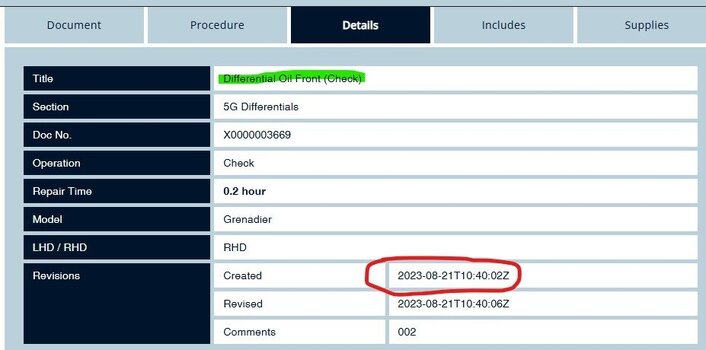
The front diff oil level check procedure is dated 2023-08-21.
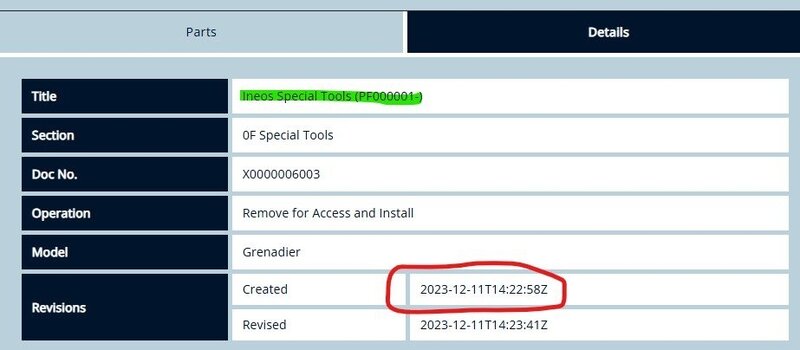
The special tools list was compiled on 2023-12-11.
Attached.
The special tools list doesn't have images and the tools are not hyperlinked in the procedures. It could be any of these:
Item 630. GRA-0F00-017410. Gauge
Item 820. GRA-0F00-017600. Filler Device
Item 850. GRA-0F00-017630. Measuring Adapter
Item 1020. GRA-0F00-017800. Gauge
Item 1100. GRA-0F00-017880. Gauge
Item 1210. GRA-0F00-017990. Gauge