The Grenadier Forum

Register a free account today to become a member! Once signed in, you'll be able to contribute to the community by adding your own topics, posts, and connect with other members through your own private inbox! INEOS Agents, Dealers or Commercial vendors please use the contact us link at the bottom of the page.

Front differential, rear differential, and transfer case fluid levels

scottg

Grenadier Owner
Local time
4:54 PM
Joined
Apr 22, 2025
Messages
119
Location
Washington DC
There have been discussions about whether you fill the front and rear diff fluids up to the fill hole, or if you're supposed to fill both up to I think it was 23mm (or 31mm?) below the bottom of the fill holes -- I forget the actual values that were being bandied about.

Has anyone found confirmation from INEOS Automotive on this?

Can someone with access to the online manual (I'm still waiting for access, months now), see if there is a description of the refill process and what those levels should be?

Would like to confirm for the transfer case as well.

Not talking about the volume they're supposed to hold, just whether they're all supposed to be filled to the bottom of their fill holes, and if not, what's the spec?

Specify what MY you have, I think the manuals limit you to just the stuff that's part of your VIN sequence.

thanks!
/s.
 
When I had mine done the tech told me they fill it to the bottom of the fill hole... Done that twice now on mine. Transfer case I didn't ask....
 
There have been discussions about whether you fill the front and rear diff fluids up to the fill hole, or if you're supposed to fill both up to I think it was 23mm (or 31mm?) below the bottom of the fill holes -- I forget the actual values that were being bandied about.

Has anyone found confirmation from INEOS Automotive on this?

Can someone with access to the online manual (I'm still waiting for access, months now), see if there is a description of the refill process and what those levels should be?

Would like to confirm for the transfer case as well.

Not talking about the volume they're supposed to hold, just whether they're all supposed to be filled to the bottom of their fill holes, and if not, what's the spec?

Specify what MY you have, I think the manuals limit you to just the stuff that's part of your VIN sequence.

thanks!
/s.

There are no servicing procedures in our view of the docs portal.

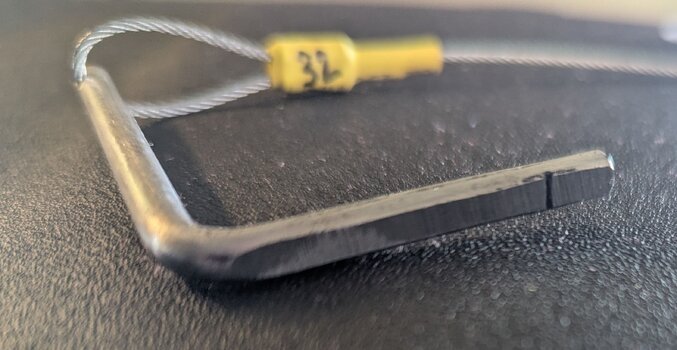
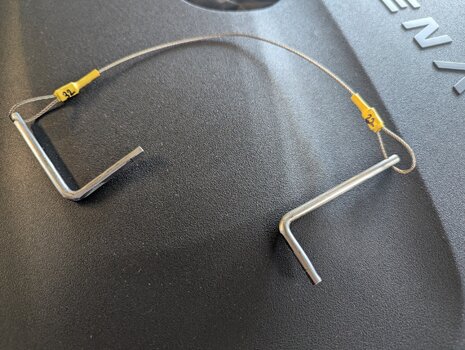
For the diffs the only spec I've seen is the fill volume of 2.1 litres per axle. I don't know the original source. Another doc in circulation, maybe it came via @Logsplitter, is the level measurement below the filler holes. 32mm below for the front axle and 22mm below for the rear axle. That's an odd setup for sure. I suspect it was reverse engineered from 2.1 litres on a level surface. Most workshops have their bulk oils on pneumatic dispenser pumps. Some might be metered, probably never calibrated. The diff oil is common 80W-90 GL5. No busy workshop is going to measure out 2.1 litres into a graduated jug then manually put it in the axle. But if 'full' is not 'fill-to-spill' someone had to come up with a method to know when to stop pumping oil in from a trigger gun. You stop pumping at 22mm and 32mm below the holes and that's 2.1 litres. You measure it with a dip tool. I made a set of measures on Sunday to do my diffs. No way I can drop them into the hole. 20 mins work.

The transfer case is less straightforward because of the remote oil cooler. I opened a case with IA customer service on Sunday to supply a copy of the drain and fill procedure. Standing by...

If we talk about this some more our Chinese aftermarket friends will seize the opportunity and make replacement diff centre covers with the fill plugs at the correct height so we can go back to fill-to-spill.
 

Attachments

  • PXL_20251230_024602327~2.jpg
    PXL_20251230_024602327~2.jpg
    920.6 KB · Views: 36
  • PXL_20251230_024544447.jpg
    PXL_20251230_024544447.jpg
    6.2 MB · Views: 31
Last edited:
There are no servicing procedures in our view of the docs portal.

For the diffs the only spec I've seen is the fill volume of 2.1 litres per axle. I don't know the original source. Another doc in circulation, maybe it came via @Logsplitter, is the level measurement below the filler holes. 32mm below for the front axle and 22mm below for the rear axle. That's an odd setup for sure. I suspect it was reverse engineered from 2.1 litres on a level surface. Most workshops have their bulk oils on pneumatic dispenser pumps. Some might be metered, probably never calibrated. The diff oil is common 80W-90 GL5. No busy workshop is going to measure out 2.1 litres into a graduated jug then manually put it in the axle. But if 'full' is not 'fill-to-spill' someone had to come up with a method to know when to stop pumping oil in from a trigger gun. You stop pumping at 22mm and 32mm below the holes and that's 2.1 litres. You measure it with a dip tool. I made a set of measures on Sunday to do my diffs. No way I can drop them into the hole. 20 mins work.

The transfer case is less straightforward because of the remote oil cooler. I opened a case with IA customer service on Sunday to supply a copy of the drain and fill procedure. Standing by...

If we talk about this some more our Chinese aftermarket friends will seize the opportunity and make replacement diff centre covers with the fill plugs at the correct height so we can go back to fill-to-spill.
The transfer case cooler is an issue for me, I want to drain and refill my transfer case before 9 or 10k miles, not confident in doing that yet. The diffs, I've read many posts, one person spoke with an INEOS rep or mechanic and they said 22 mm for front diff, 32 mm for rear, as you write above. I'm not certain that any mechanic randomly selected will realize that they need to fill Grenadier diffs to those specs, they'll fill to the bottom of the fill hole. So is it really 22mm for front, and 32mm for rear?

I've noticed over the last few decades that all vehicles essentially have settled on the same ways to arrange the windshield wipers, lights, and other stuff around the steering column. Having diffs that require fluid levels to be specific mm's below the fill holes kind of breaks things in a sense, because most mechanics will do what they have always done, fill to the bottom of the fill hole.
 
I don't think the dimension is the key criteria. Put 2.1 litres in. If you cannot accurately dispense 2.1 litres then measure the height to the surface of the oil and adjust until it's correct. Like an old school engine dipstick.
I did my diffs on Monday. I drained them and got near enough to 2.1 litres out. I put 2.1 litres into a pump pack plus another 200ml for the trapped oil in the pump and hose. I pumped it all in then measured. Close enough to 32 and 22mm. I topped up maybe another 30ml each to hit the line on my redneck dipsticks.
A big oil transfer syringe would be the go. Prime the syringe and hose with oil. Bottom the plunger. Draw up 2.1 litres. Squirt it in. Close up. Sleep at night.
 
There are no servicing procedures in our view of the docs portal.

For the diffs the only spec I've seen is the fill volume of 2.1 litres per axle. I don't know the original source. Another doc in circulation, maybe it came via @Logsplitter, is the level measurement below the filler holes. 32mm below for the front axle and 22mm below for the rear axle. That's an odd setup for sure. I suspect it was reverse engineered from 2.1 litres on a level surface. Most workshops have their bulk oils on pneumatic dispenser pumps. Some might be metered, probably never calibrated. The diff oil is common 80W-90 GL5. No busy workshop is going to measure out 2.1 litres into a graduated jug then manually put it in the axle. But if 'full' is not 'fill-to-spill' someone had to come up with a method to know when to stop pumping oil in from a trigger gun. You stop pumping at 22mm and 32mm below the holes and that's 2.1 litres. You measure it with a dip tool. I made a set of measures on Sunday to do my diffs. No way I can drop them into the hole. 20 mins work.

The transfer case is less straightforward because of the remote oil cooler. I opened a case with IA customer service on Sunday to supply a copy of the drain and fill procedure. Standing by...

If we talk about this some more our Chinese aftermarket friends will seize the opportunity and make replacement diff centre covers with the fill plugs at the correct height so we can go back to fill-to-spill.

What do you mean "There are no servicing procedures in our view..."?
 
What do you mean "There are no servicing procedures in our view..."?
Our 'view' is what we can see in the portal.

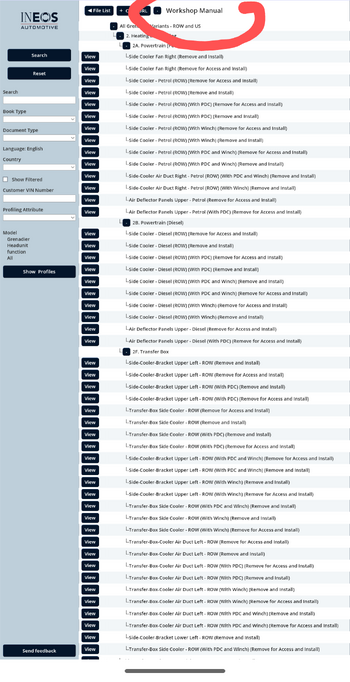
The access permissions that IA have granted excludes any servicing procedures. We get some general docs, the parts catalogue, the body repair manual, and a workshop manual. That's all remove and install docs. Nothing on inspections, adjustments, damage limits, etc. The workshop manual does include installation torques.

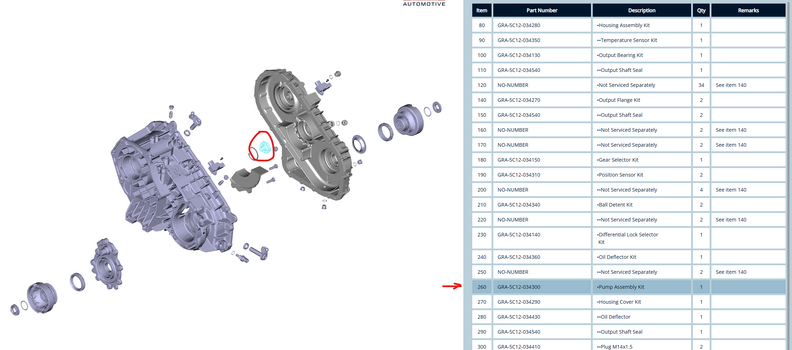
Edit: There is some component oil drain and fill information.
 

Attachments

  • Screenshot_20251230-135708.png
    Screenshot_20251230-135708.png
    176.9 KB · Views: 29
  • Screenshot_20251230-135756.png
    Screenshot_20251230-135756.png
    698.5 KB · Views: 35
Last edited:
Hmmm, slightly different numbers. I wonder where 22mm and 32mm came from? I didn't make them up. I'm still of the opinion that it's the 2.1 litres that matters.
Found them. I was quoting the numbers from here not the doc you posted @Logsplitter.
https://www.theineosforum.com/threads/transfer-case-oil-change-procedure.12417125/post-1333336895

2.1 litres axle oil capacity is in the fluids quick reference guide supplied by IA. It's in the resources section.

And 2.1 litres is the maximum fill quantity for both axles as listed in the workshop manual.
 
Last edited:
Hmm at the end of the day I reckon just put the correct amount of oil in and don't overthink it. I'd be happy with levels between 22 and 27mm (front) or 33mm (Rear)

As an aside I've always been uncomfortable with the precision of the front diff level (27.3mm) in the document @Logsplitter posted. I doubt anyone could measure reliably to <1mm.

Cheers
Steve
 
Most folk doing a DIY drain and fill won’t be checking their diff fluid levels on anything approaching a level enough surface and will get somewhat inaccurate readings anyway. Best scenario would be on a level four post lift with the vehicles weight sitting on its wheels. Drooping axles on a two post lift would mess with the fluid level readings even more (even though I’ve seen dealers do it this way). Better to use a finely graduated painters bucket to measure what comes out and check against specifications and make sure the exact correct amounts go back in each axle. Then check with your improvised measurement tool to double check and adjust as necessary to get the levels just so.
 
Just adjusting your caster will change all of this 🙄 I'm going to try to hold my tongue on this thread as best I can.

Fill to spill and be done with it. Stop nuking everything. I would put money on it your dealer fills to spill regardless of anything Ineos publishes.

I was a Land Rover tech and I guarantee had they come out with some BS like this we would have all ignored it. Mechanics move fast and we wouldn't waste time on something so inconsequential.

And don't get me started on torquing every bolt to spec. 😂 I've seen some crazy stuff in the mechanic world.
 
The transfer case cooler is an issue for me, I want to drain and refill my transfer case before 9 or 10k miles, not confident in doing that yet. The diffs, I've read many posts, one person spoke with an INEOS rep or mechanic and they said 22 mm for front diff, 32 mm for rear, as you write above. I'm not certain that any mechanic randomly selected will realize that they need to fill Grenadier diffs to those specs, they'll fill to the bottom of the fill hole. So is it really 22mm for front, and 32mm for rear?

I've noticed over the last few decades that all vehicles essentially have settled on the same ways to arrange the windshield wipers, lights, and other stuff around the steering column. Having diffs that require fluid levels to be specific mm's below the fill holes kind of breaks things in a sense, because most mechanics will do what they have always done, fill to the bottom of the fill hole.

I have just changed my transfer case oil (only). It's not difficult. You just need to keep an eye on how much oil drains out so you put it all back in again. This was the transfer case oil only so 1.8 litres out of 2.64 litres total oil capacity, or 68%.
I still have an open case with IA customer service for a document that covers a combined transfer case and oil cooler drain and fill. In the interim I used the available documents to change the transfer case oil.

Transfer Case Oil Change
The recommended oil is Fuchs Titan Sintopoid 75W-90. 75W-85 is also acceptable. See the Ineos provided Quick Reference Guide (fluid) Specifications available from here and @Rok_Dr's Owner's Manual Supplement here.
The transfer case oil capacity is 1.8 litres. The combined oil capacity of the transfer case and the oil cooler and plumbing is 2.64 litres.

There are two distinct documents visible in the workshop manual concerning the transfer case oil:
1. Transfer Box Oil (Check). This includes instructions to fill-to-spill when adding oil to the transfer case.
2. Transfer Box Oil (Drain and Fill). (two docs appear with a different ID# but have the same content). These instructions are for a drain and refill using the same oil. It's the same process to do an oil change.
I have screen grabbed those procedures into the attached pdf.

To be certain I had not lost any oil from the cooler circuit, after I refilled the transfer case I temporarily reinstalled the filler plug then idled my vehicle back and forth on my level driveway a couple of times. This was to operate the oil pump in the transfer case (see below) to ensure the cooler circuit was full. I also operated the CDL and changed from high to low to high to ensure all parts of the transfer case were full of oil.
I then did a 2nd oil level check at the transfer case. It was still full and spilling. If the level had dropped I would have topped up and repeated the process until the oil level stabilised. If you did this job on a hoist you could do it with the wheels turning in 1st gear while clear of the ground. When the transfer case won't accept any more oil you know everything is full.

Notes:
1. I did the oil change cold. No particular reason other than it was already a hot day without working around hot oil as well.
2. To ensure I was only draining the transfer case I measured how much oil came out. I collected ~1.8 litres. When I replenished the transfer case I ensured that ~1.8 litres of new oil went in.
3. There was ~0.84 litres (2.64 - 1.8) of old oil still in the oil cooler and pipework (see below). The old oil looked clear and there was nil debris on the plugs so I left that oil in the system for now.
4. The drain and filler plugs are sealed with o-rings and torqued to 15Nm.

Oil Cooler and Pipes
There is no drain plug on the oil cooler and no service point in the pipework. There are separate documents in the workshop manual concerning Transfer Box Oil Pipes (Disconnect and Connect) and Transfer Box Oil Cooler (Remove for Access and Install). Those docs simply state to add additional oil when doing the after-maintenance oil level checks. I'll update this post if I get something from IA on how to do an oil change on the transfer case and oil cooler at the same time. I know how I would do it but I first want to see if there is an IA procedure.

Transfer Case Oil Pump
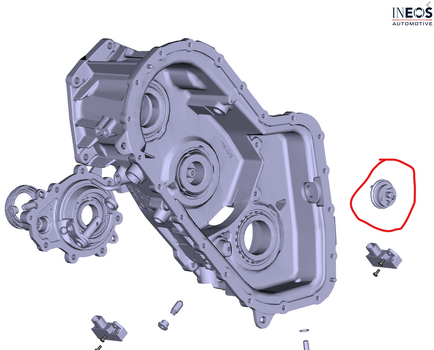
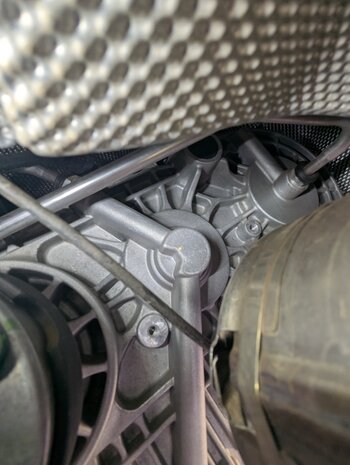
There is a gerotor style mechanical oil pump inside the transfer case. This pump is mounted in the rear cover of the transfer case and driven by the intermediate shaft. It circulates oil to and from the cooler whenever the vehicle is moving (the intermediate shaft must be turning). A Gerotor is a positive displacement pump so oil should not drain through it when it is not operating.

 

Attachments

Thank you for documenting the process in such great detail. There were suggestions that there was a pump that could be activated electronically to push fluid out of the cooling circuit but you're clearly showing it's mechanical -- putting the ZF into forced-neutral, lifting the Grenadier and manually turning the wheels to operate that pump, probably not efficient and might not even work, but would serve as excellent physical exercise :) I am still waiting for access to the online manuals -- received email to request access on 3 October and submitted my information, have not heard back yet.
 
Thank you for documenting the process in such great detail. There were suggestions that there was a pump that could be activated electronically to push fluid out of the cooling circuit but you're clearly showing it's mechanical -- putting the ZF into forced-neutral, lifting the Grenadier and manually turning the wheels to operate that pump, probably not efficient and might not even work, but would serve as excellent physical exercise :) I am still waiting for access to the online manuals -- received email to request access on 3 October and submitted my information, have not heard back yet.
It's another query off the list. I believe owners now have enough information to do all the oil changes should they want to, or need to due to dealer location.

The pump appears to be quite small which might explain why the greatest temperature rise in the transfer case appears to be during sustained high speed driving. That's my experience. The cooler is more than likely adequate to shed the heat but the pump cannot circulate the oil fast enough to keep ahead of the temperature rise.
 
Back
Top Bottom